
Welcome to ScapeCrunch
We are ScapeCrunch, the place where planted aquarium hobbyists come to build relationships and support each other. When you're tired of doom scrolling, you've found your home here.
Social Feed
Chapter 1: Growing plants with heavy fertilisation in the water column
Introduction
Plants differ not only in shape, color, size or growth rate, but also in their requirements or preferences. While all plants need water, light, heat, nutrients and the absence of harmful influences to grow well, some need to have these mixed in a specific ratio. In a way, it's similar to humans: while some people are not too picky about food (they'll eat anything), gourmets are picky eaters (they despise ordinary food). Similarly, some plants will grow in almost any circumstances (in acidic or alkaline water, in low or high light, in sand or organic soil, in nutrient-poor or nutrient-rich water), while others are a little more "spoiled" and therefore require more specific environmental parameters (whether it concerns the intensity of the light, the physico-chemical parameters of the water, or the composition and characteristics of the substrate). Figuring out what each plant prefers (or downright requires) is not easy. First of all, it requires us to identify all the relevant factors that play a significant role → e.g. pH, redox, organic compounds, light intensity, temperature, content and ratio of different nutrients, substrate properties, microbial composition, etc. These factors then need to be tested in order to clarify the extent to which they influence the outcome - i.e. the growth and condition of our plants. This experiment is an attempt to test a particular set of factors that I have identified as potentially important. [I am by no means claiming that my selection is the most important or comprehensive. But I have to start somewhere.] In each of the eight aquariums, I used a different recipe (i.e., a different set of factors) in the hope of revealing the particular preferences of each [tested] plant. This experiment, however, is only a sort of "first chapter" in a series of other tests that I plan to carry out gradually. I believe, however, that it may provide valuable partial insights from which a more complete picture (mosaic) of our aquarium plants and their needs (preferences) can be assembled over time. More detailed information and further experiments can be found [if interested] on my website: golias.net/akvaristika/.
The main objective
To identify the optimal parameters for cultivation of aquarium plants.
Aquariums
Eight identical aquaria → 20 liters or 5 gallons (net volume) each
Plants
In this experiment I decided to use the following emersion plants (i.e. plants grown in a greenhouse):
Diagram of plant placement in individual aquariums ↓

Picture of the fifth aquarium (few days old) ↓

Picture of all eight experimental aquariums ↓

Light
Lighting interval: 8h/day
Light intensity (PAR) in individual aquariums:

Note: There was no difference between the values in the middle vs. at the corners of the aquarium on the horizontal axis (except for the top section = near the light source).


↑ Measured with Apogee MQ-610 (full-spectrum quantum meter). The measured values were [in accordance with the manufacturer's instructions] converted for an underwater environment using a correction factor of 1.25.
Substrate
While in the first set (aquaria #1 to #4) a substrate for aquatic plants covered with a layer of pure silica sand was used, in the second set (aquaria #5 to #8) no substrate was used.
1st set → nutrient-rich substrate

2nd set → no substrate

Because the organic substrate should contain sufficient N, P and micronutrients (NPµ), these nutrients were not added to the water column; I assumed that some N and P would be leached from the substrate into the water column anyway.
I used a local horticultural substrate for aquatic plants capped with a layer of silica sand.
In aquariums without substrate, I used M16 stainless steel hexagonal nuts inserted into small hydroponic net pots (Ø 5 cm = 2") to anchor the plants. The stems in the nuts were held in place by a small strip of coarse foam.
Water
Note: The recipes below were prepared using pure (demineralized/deionized) reverse osmosis water.

Documentation
planting: 2024-10-04


week #1: 2024-10-12


week #2: 2024-10-19


week #3: 2024-10-26


week #4: 2024-11-02


Details (first experimental set: aquaria #1 to #4):

Details (second experimental set: aquaria #5 to #8):

week #5: 2024-11-09


week #6: 2024-11-16


week #7: 2024-11-23


Results
Note: In the first weeks a brown haze was visible in the first experimental set (from leached humic substances from freshly flooded substrate).
The following data is a brief description of the visual condition of the plants in each aquarium (1 to 8). Green indicates best condition, blue indicates good condition and red indicates fair condition.
The pH values below represent the average measured in the last weeks of the experiment.
Ammannia pedicellata 'Gold'

Hygrophila corymbose

Pogostemon deccanensis

Rotala wallichii

Evaluation
Keep in mind that:

Ammannia pedicellata 'Gold'
Probable characteristics:

Hygrophila corymbosa
Probable characteristics:

Pogostemon deccanensis
Note: The purchased plants were not in the best condition, so their onset was considerably delayed (they started to show some growth only from about the third week). Also, this plant [appears] to show no marked signs of deficiency and is therefore not a suitable indicator of malnutrition.
Probable characteristics:

Rotala wallichii
Probable characteristics:

Introduction
Plants differ not only in shape, color, size or growth rate, but also in their requirements or preferences. While all plants need water, light, heat, nutrients and the absence of harmful influences to grow well, some need to have these mixed in a specific ratio. In a way, it's similar to humans: while some people are not too picky about food (they'll eat anything), gourmets are picky eaters (they despise ordinary food). Similarly, some plants will grow in almost any circumstances (in acidic or alkaline water, in low or high light, in sand or organic soil, in nutrient-poor or nutrient-rich water), while others are a little more "spoiled" and therefore require more specific environmental parameters (whether it concerns the intensity of the light, the physico-chemical parameters of the water, or the composition and characteristics of the substrate). Figuring out what each plant prefers (or downright requires) is not easy. First of all, it requires us to identify all the relevant factors that play a significant role → e.g. pH, redox, organic compounds, light intensity, temperature, content and ratio of different nutrients, substrate properties, microbial composition, etc. These factors then need to be tested in order to clarify the extent to which they influence the outcome - i.e. the growth and condition of our plants. This experiment is an attempt to test a particular set of factors that I have identified as potentially important. [I am by no means claiming that my selection is the most important or comprehensive. But I have to start somewhere.] In each of the eight aquariums, I used a different recipe (i.e., a different set of factors) in the hope of revealing the particular preferences of each [tested] plant. This experiment, however, is only a sort of "first chapter" in a series of other tests that I plan to carry out gradually. I believe, however, that it may provide valuable partial insights from which a more complete picture (mosaic) of our aquarium plants and their needs (preferences) can be assembled over time. More detailed information and further experiments can be found [if interested] on my website: golias.net/akvaristika/.
The main objective
To identify the optimal parameters for cultivation of aquarium plants.
Aquariums
Eight identical aquaria → 20 liters or 5 gallons (net volume) each
Plants
In this experiment I decided to use the following emersion plants (i.e. plants grown in a greenhouse):
- Ammannia pedicellata 'Gold' (formerly known as Nesaea sp. Gold)
- Hygrophila corymbosa
- Pogostemon deccanensis (formerly known as P. erectus)
- Rotala wallichii
Diagram of plant placement in individual aquariums ↓
Picture of the fifth aquarium (few days old) ↓
Picture of all eight experimental aquariums ↓
Light
Lighting interval: 8h/day
Light intensity (PAR) in individual aquariums:
- top: 231 µM/m2·s → just below the water surface
- middle: 98 µM/m2·s
- bottom: 96 µM/m2·s → at the bottom
Note: There was no difference between the values in the middle vs. at the corners of the aquarium on the horizontal axis (except for the top section = near the light source).
↑ Measured with Apogee MQ-610 (full-spectrum quantum meter). The measured values were [in accordance with the manufacturer's instructions] converted for an underwater environment using a correction factor of 1.25.
Substrate
While in the first set (aquaria #1 to #4) a substrate for aquatic plants covered with a layer of pure silica sand was used, in the second set (aquaria #5 to #8) no substrate was used.
1st set → nutrient-rich substrate
2nd set → no substrate
Because the organic substrate should contain sufficient N, P and micronutrients (NPµ), these nutrients were not added to the water column; I assumed that some N and P would be leached from the substrate into the water column anyway.
I used a local horticultural substrate for aquatic plants capped with a layer of silica sand.
In aquariums without substrate, I used M16 stainless steel hexagonal nuts inserted into small hydroponic net pots (Ø 5 cm = 2") to anchor the plants. The stems in the nuts were held in place by a small strip of coarse foam.
Water
Note: The recipes below were prepared using pure (demineralized/deionized) reverse osmosis water.
- Water flowensured by a surface skimmer (Jingye JY-350)
- no filtration used
- Water changes done once a week (with 50% of the water changed) with macro-nutrients replenishment
- Micro-nutrients added every other day (most in the form of EDTA chelates, iron in the form of gluconate + DTPA)
- Extra CO2 added to aquaria #1, #3, #5 and #7 using a simple glass diffuser, the function and parameters of which are described in more detail in a separate article
- target CO2 concentration in these aquaria: ~15 ppm
- The pH fluctuated or decreased during the experiment (in some aquariums quite significantly) → see photo documentation for week #4.
Documentation
planting: 2024-10-04
week #1: 2024-10-12
week #2: 2024-10-19
week #3: 2024-10-26
week #4: 2024-11-02
Details (first experimental set: aquaria #1 to #4):
Details (second experimental set: aquaria #5 to #8):
week #5: 2024-11-09
week #6: 2024-11-16
week #7: 2024-11-23
Results
Note: In the first weeks a brown haze was visible in the first experimental set (from leached humic substances from freshly flooded substrate).
The following data is a brief description of the visual condition of the plants in each aquarium (1 to 8). Green indicates best condition, blue indicates good condition and red indicates fair condition.
The pH values below represent the average measured in the last weeks of the experiment.
Ammannia pedicellata 'Gold'
Hygrophila corymbose
Pogostemon deccanensis
Rotala wallichii
Evaluation
Keep in mind that:
- Higher light (more energy) = higher nutrient demand (especially CO2) = higher risk of deficiency
- In the first experimental set, NPμ is absent in the water column and plants there depend on NPμ in the sediment, which might have [negatively] affected the result (yield/condition) compared to the second experimental set → causing NPμ deficiency or heavy metal (or hydrogen sulphide) toxicity in the sediment
Ammannia pedicellata 'Gold'
Probable characteristics:
Hygrophila corymbosa
Probable characteristics:
Pogostemon deccanensis
Note: The purchased plants were not in the best condition, so their onset was considerably delayed (they started to show some growth only from about the third week). Also, this plant [appears] to show no marked signs of deficiency and is therefore not a suitable indicator of malnutrition.
Probable characteristics:
Rotala wallichii
Probable characteristics:
34 Replies
·
4736 views


I have a wonderful stand of erio feather duster that has been algae free for well over a year.
Wnen I firts got it, tufts of bba would form on it on tips and I would just pull them off…
This summer my display tank has been struggling with simmering algae issues.
Still doing weekly 2/3 water changes, keeping nutrient levels and all stable, trimming away degraded leaves…
My erio is in sad shape…
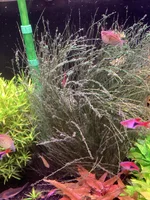
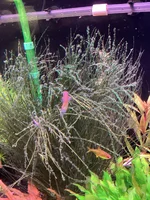
I have tried spraying peroxide on it when doing water changes, laying the mass on a cafeteria tray and spraying on full strength and letting it set for 10 minutes before refilling to no avail.
I gave the fikters a thorough cleaning out, andremoved and reset plant groupings after thoroughly gravel vaccing the bdbs to remove organics…
Iam starting to think giving the erio a good hair cut way down low and letting it send up all new leaves.
Figure I would poll the audience before taking any such action…
Wnen I firts got it, tufts of bba would form on it on tips and I would just pull them off…
This summer my display tank has been struggling with simmering algae issues.
Still doing weekly 2/3 water changes, keeping nutrient levels and all stable, trimming away degraded leaves…
My erio is in sad shape…
I have tried spraying peroxide on it when doing water changes, laying the mass on a cafeteria tray and spraying on full strength and letting it set for 10 minutes before refilling to no avail.
I gave the fikters a thorough cleaning out, andremoved and reset plant groupings after thoroughly gravel vaccing the bdbs to remove organics…
Iam starting to think giving the erio a good hair cut way down low and letting it send up all new leaves.
Figure I would poll the audience before taking any such action…
1 Replies
·
5 views

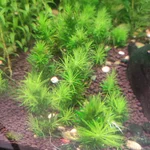 How long does it take for this plant to convert from emersed to submerged? I've had these for a month and this is what it looks like. A bit of new growth, but I don't know if it's normal to wait that long or if it's stunting. The emersed stems were tiny also.
Another general query is what is your general experience with the plant?
10 Replies
·
521 views

Supporting
I Donated 2026
Rockstar
Inspired by @Naturescapes_Rocco ’s no-tech bowl thread, I decided to set up something similar.
With all the highs and lows of running a high-tech planted tank, I was hoping to put together something much simpler—a small bowl with no filter, no CO₂, and minimal equipment.
12" diameter × 10" height
Approximately 3 gallons
5 watts
At the end of the two weeks, ammonia remained super high.
I eventually got impatient, did about a 90% water change, and planted the bowl.
Current plants include:
A 75% water change takes less than 10 minutes.
For the last couple of weeks after planting, I’ve been doing water changes approximately every 2–3 days.
Maybe it’s the fresh aquasoil, but the pH has been sitting around 6.6. For comparison, my main high-tech tank with APT Feast (about a year old) sits around pH 7 before the CO₂ comes on.
Plant growth has been surprisingly good. I also frequently see the plants pearling, which I wasn’t necessarily expecting from a little no-tech setup like this. The L.heterophylla has been trimmed once.
What has been particularly interesting is how easily plants taken directly from my high-tech tank seem to have transitioned to these very different conditions.
A bladder snail somehow hitchhiked in with the plants. It seems perfectly happy and has already started reproducing.
With the relatively low pH, I suspect much of the measured ammonia is present as the less-toxic ammonium form, which may also explain why the snail seems completely unbothered.
I am starting to see the power of frequent water changes with the lack of algae so far (fingers crossed).
For such a small volume of water, APT Feast may simply be more nutrient-rich than necessary. I’m curious to see how things evolve once the bowl matures.
2. Choose a different light.
The light itself works fine, but the built-in timer is frustrating.
If I turn the light on at night just to look at the bowl, it interrupts the timer cycle, and I then have to reset it the following day.
I’m not particularly handy with electrical work, but ideally I’d love a simple light that could just be plugged into a Kasa smart plug and controlled externally.
If anyone has recommendations for a good small bowl light that works that way, let me know.
Overall, though, I’m really enjoying the simplicity of this setup so far.
Looking forward to letting it mature a little more and hopefully adding some red cherry shrimp soon.
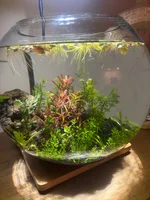
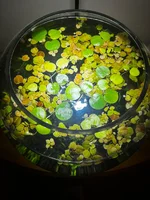
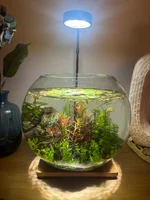
With all the highs and lows of running a high-tech planted tank, I was hoping to put together something much simpler—a small bowl with no filter, no CO₂, and minimal equipment.
Bowl
WGV Large Glass Bowl Vase12" diameter × 10" height
Approximately 3 gallons
Light
AREPK Aquarium & Terrarium Full Spectrum LED5 watts
Substrate / Hardscape
- APT Feast
- A single lava rock
Water
RO water remineralized with APT SkyFertilizer
None so far.Dark Start
I did a dark start for about 2 weeks after squeezing some mulm from an established filter into the bowl.At the end of the two weeks, ammonia remained super high.
I eventually got impatient, did about a 90% water change, and planted the bowl.
Plants
My initial goal was to use relatively fast-growing plants to help stabilize the system. Some of these may not necessarily remain in the bowl long term.Current plants include:
- Limnophila heterophylla
- Pearlweed
- Rotala ‘Blood Red’
- Helanthium tenellum
- Trident Java fern
- Mini Bolbitis
- A few assorted stems from my main tank
- Some nice floating plants
Water Changes
One of the biggest advantages of a bowl this size is how easy maintenance is.A 75% water change takes less than 10 minutes.
For the last couple of weeks after planting, I’ve been doing water changes approximately every 2–3 days.
Experience So Far
So far, the water has remained crystal clear.Maybe it’s the fresh aquasoil, but the pH has been sitting around 6.6. For comparison, my main high-tech tank with APT Feast (about a year old) sits around pH 7 before the CO₂ comes on.
Plant growth has been surprisingly good. I also frequently see the plants pearling, which I wasn’t necessarily expecting from a little no-tech setup like this. The L.heterophylla has been trimmed once.
What has been particularly interesting is how easily plants taken directly from my high-tech tank seem to have transitioned to these very different conditions.
A bladder snail somehow hitchhiked in with the plants. It seems perfectly happy and has already started reproducing.
With the relatively low pH, I suspect much of the measured ammonia is present as the less-toxic ammonium form, which may also explain why the snail seems completely unbothered.
I am starting to see the power of frequent water changes with the lack of algae so far (fingers crossed).
Things I Might Do Differently Next Time
1. Use a less nutrient-rich substrate or cap the aquasoil.For such a small volume of water, APT Feast may simply be more nutrient-rich than necessary. I’m curious to see how things evolve once the bowl matures.
2. Choose a different light.
The light itself works fine, but the built-in timer is frustrating.
If I turn the light on at night just to look at the bowl, it interrupts the timer cycle, and I then have to reset it the following day.
I’m not particularly handy with electrical work, but ideally I’d love a simple light that could just be plugged into a Kasa smart plug and controlled externally.
If anyone has recommendations for a good small bowl light that works that way, let me know.
Overall, though, I’m really enjoying the simplicity of this setup so far.
Looking forward to letting it mature a little more and hopefully adding some red cherry shrimp soon.
17 Replies
·
841 views


Supporting
I Donated 2026
Rockstar
Well...let's spend more money! I had thought about attending Aquashella - Chicago a few months ago but decided to pass this year. When I was thinking about it, they still didn't have the specific VIP guest list posted. Out of curiosity, I checked today and to my surprise, the man himself, Yusuke Homma, will be presenting the masterclass on Saturday. I can't pass that up when it's only an 8 hour drive. Ticket purchased, room booked. Anyone else attending?
21 Replies
·
478 views

Supporting
I Donated 2026
AquaGirls
I wasn't quite sure what to do with this tank after it was damaged, as I have been a little concerned with the corner chip that it may leak. My initial thought was to just propagate some mosses in it, or turn it into a small paludarium, as that would not require me to fill it all the way with water. Well, I couldn't help myself. Found some lovely pieces of sturdy Manzanita that worked well together, and the next thing you know, 45lbs of Manten Stone shows up on the door step. Before hitting Aquashella in New Jersey, it was almost through the dark start.
Hardware:
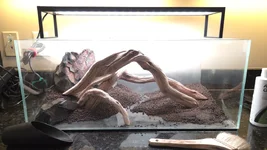
Finished hardscape:
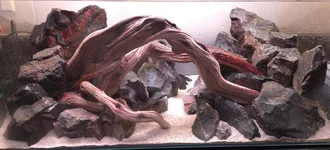
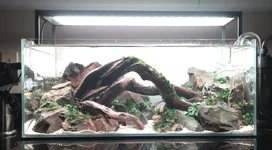
This tank is intended to be slow, and low maintenance. Inspired by Jeff Senske's 'greening' method, this is principally an epiphyte tank, and there are no stems. However, it was a fun challenge to work in a relatively tight space, especially front-to-back, and play with scale.
I drained the tank yesterday, and started planting.
Foreground:
Midground:
Background:
As the tank was in a dark start when the mosses arrived, I tied them to rocks, and dropped them in a tank with CO2 until I was ready to plant. Worked quite well, and was easy to just snip the Terra Line off and transfer the moss to the driftwood when planting. Kept it healthy, and growing. Of course, if I was smart, I would NOT have glued the wood down prior to the dark start. That made tying Fissidens to the wood a bit challenging yesterday, but finally got it done.
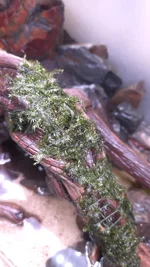
Fissidens fontanus wasn't too bad, as the main arch is elevated a bit more
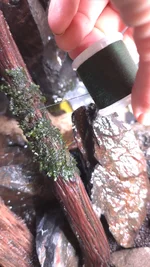
Fissidens crispulus was a bit more tricky on the secondary arch, as that rock was squarely in the way. I noticed that crispulus was already pushing new green tips, as was the notoriously slow growing Miroshaki.
I am not a huge fan of gluing moss or epiphytes, if I can avoid it, mostly because it messes up the hardscape. The majority of the buce and anubias species were simply wedged into crevices in the rocks.
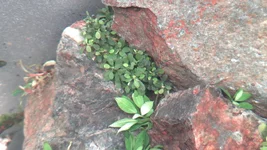
As there was a little exposed aquasoil on the left and right rear flanks, I grabbed the pot of Marsilea minuta I picked up at Aquashella, and stuffed a few in high back corners. I was going to put some HC Cuba back there, and still might, but will be using most of it in the Sensei Stone tank, so didn't want to open the TC just yet. Once I plant that tank, I might sneak a little Cuba into this tank.
I am not sure that a plant can really be adorable, but seriously, Bucephalandra 'Petite Galaxy', next to Anubias Pangolino? This buce is truly teeny tiny, and IF it survives, might be my new favorite detailing plant.
As the Tank is shallow, and the plants are slow, I am starting out at around 28% light intensity while the plants, mostly TC, settle in. Will dose for the next 7 days with Seachem Flourish Advance, and am starting the tank out with APT1.
Here's hoping the plant melting and algae gods are kind!
Hardware:
- ADA Cube Garden 60F (60 x 30 x 25 cm)
- Chihiros WRGB II Slim 60
- Oase Filtosmart 100
- Jardli Lily Pipes (12/16mm)
- GLA Cartridge CO2 Kit
- Ancient Manten Stone (ARC) - 45lbs
- Manzanita (sand blasted) - 4 pieces
- UNS Controsoil Black (normal & fine)
- ADA La Plata Sand
Finished hardscape:
This tank is intended to be slow, and low maintenance. Inspired by Jeff Senske's 'greening' method, this is principally an epiphyte tank, and there are no stems. However, it was a fun challenge to work in a relatively tight space, especially front-to-back, and play with scale.
I drained the tank yesterday, and started planting.
Foreground:
- Bucephalandra Kedagang Japan
- Anubias nana 'Petite'
- Fissidens nobilis
Midground:
- Bucephalandra Lamandau Mini Purple
- Bucephalandra Kedagang 'Round Mini'
- Anubias minima 'Dragon Claw'
- Anubias barteri var. nana 'Mini Coin'
- Fissidens fontanus (Manzanita)
- Fissidens crispulus
Background:
- Bucephalandra 'Petite Blue Chili'
- Bucephalandra 'Petite Galaxy'
- Anubias barteri var. nana 'Pangolino'
- Fissidens Miroshaki
As the tank was in a dark start when the mosses arrived, I tied them to rocks, and dropped them in a tank with CO2 until I was ready to plant. Worked quite well, and was easy to just snip the Terra Line off and transfer the moss to the driftwood when planting. Kept it healthy, and growing. Of course, if I was smart, I would NOT have glued the wood down prior to the dark start. That made tying Fissidens to the wood a bit challenging yesterday, but finally got it done.
Fissidens fontanus wasn't too bad, as the main arch is elevated a bit more
Fissidens crispulus was a bit more tricky on the secondary arch, as that rock was squarely in the way. I noticed that crispulus was already pushing new green tips, as was the notoriously slow growing Miroshaki.
I am not a huge fan of gluing moss or epiphytes, if I can avoid it, mostly because it messes up the hardscape. The majority of the buce and anubias species were simply wedged into crevices in the rocks.
As there was a little exposed aquasoil on the left and right rear flanks, I grabbed the pot of Marsilea minuta I picked up at Aquashella, and stuffed a few in high back corners. I was going to put some HC Cuba back there, and still might, but will be using most of it in the Sensei Stone tank, so didn't want to open the TC just yet. Once I plant that tank, I might sneak a little Cuba into this tank.
I am not sure that a plant can really be adorable, but seriously, Bucephalandra 'Petite Galaxy', next to Anubias Pangolino? This buce is truly teeny tiny, and IF it survives, might be my new favorite detailing plant.
As the Tank is shallow, and the plants are slow, I am starting out at around 28% light intensity while the plants, mostly TC, settle in. Will dose for the next 7 days with Seachem Flourish Advance, and am starting the tank out with APT1.
Here's hoping the plant melting and algae gods are kind!
3 Replies
·
60 views


Rockstar
Journal 62G AIO Dirty Soil Lagoon

Well I’m done talking about it, it’s time to get this journal started.
I have been really out of it the last year or so in terms of maintaining my own tank, mainly out of frustration with time constraints and inconsistency with dosing etc. However, I have now acquired a dream tank, rimless and with low iron glass like I’ve always wanted. While I loved having a sump and prided myself on putting it together, I’m past that desire. The AIO allows the same benefits with hiding equipment, and overall easier maintenance without climbing in and out of cabinets. Now onto the details of this build.
Tank: Planet Aquariums Tideline 62 Gallon AIO Lagoon
Filtration: (2) 250gph pumps on either side of the tank with center overflow into socks (I’m going to punch holes in the socks for now and stuff with polyfill, reviews state the socks clog way too quickly and there is no replacement sock as the insert is not the common round style). The baffles will be stuffed with the poret foam I have already from my sump for extra mechanical/biological.
Substrate: The bottom layer will comprise of bagged pond soil/peat/earthworm castings/ STS. This will be a thin layer and will mainly act as filler to raise up the cap of APT Feast. This is similar to a substrate setup I did when I first started back up in 2020, And that tank did very well. While capping with sand and relying on the dirt to feed the stems worked well, it did require a little more effort on my end with dosing. I don’t trust myself to be as diligent as some members on here are with their inert subs, so I’m taking the mulligan and using aquasoil as a cap, hence, “dirty soil.” This will be another island style layout, and the surrounding substrate will be comprised of Caribsea Carolina Creek Sand.
Hardscape: River rock (local hardscape center sourced) and malaysian driftwood. I have recently acquired another large piece of wood and I’m sourcing new stone this week, as what I have just isn’t meshing with my current vision for the tank.
Plants: …. I have not solidified my vision of what this scape will look like just yet as I haven’t been able to setup the hardscape to outline the island. The plan is to use a good amount of colorful stems, epiphytes, and potentially moss.
Lighting: I will be ordering the Week Aqua Z400 this week and am excited to test it out.
That’s all for now, more pictures and details to come. I should hopefully have the hardscape setup by the end of this coming week after acquiring more stone and wood.
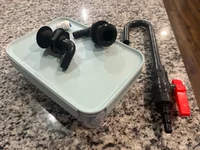
CO2: Almost forgot, for Co2 injection I have made a DIY Yugang with a locking food storage container. It will be stored in the cabinet and the hook will feed into the return pump chamber on the right. I initially was bummed that I had to sacrifice storage to fit a 5lb CO2 tank under the stand, which also meant getting rid of of the 20lb tank I’ve only been having to fill twice a year. @GreggZ Will appreciate this, my awesome father in law suggested that I hide the co2 tank in the pantry closet which is directly behind that wall and just drill a hole for the co2 line. Since my father in laws word is pure gold in my wife’s eyes, that suggestion was approved! He’s just as much my dad too so I appreciated him supporting the project

61 Replies
·
4434 views

Journal Farmer D. Singh's journal
Ive reorganized the order of my tanks so I can better keep track of them ie. Tank 2 moss tank is now tank 3. This helps in any confusion I had when tracking tanks they are in a sort of order now. Rather than taking time editing my old journal id rather create a new thread. Pics will be current (for the most part) as they are posted. I am not aquascaping. I am just farming.
74 Replies
·
4116 views

Staff member
I Donated 2026
Founding Member
The theme for this month's contest is: Algae Patina

This one is going to be tough but I hope some of you take up the challenge. There is a fine line between algae on an object that makes it look natural and old (patina) and algae on an object that simply makes it look unkept and dirty.
Who can strike that balance best??
Please take a picture of algae patina in your aquarium. Be as artistic and creative as you like.
The rules:
A $25 store credit from BurrAqua thanks to @Burr740!

Good luck!
This one is going to be tough but I hope some of you take up the challenge. There is a fine line between algae on an object that makes it look natural and old (patina) and algae on an object that simply makes it look unkept and dirty.
Who can strike that balance best??
Please take a picture of algae patina in your aquarium. Be as artistic and creative as you like.
The rules:
- Submissions are allowed between September 11 and September 23.
- Voting will start on September 23 at 12:01 am Eastern time.
- Voting will end on September 30 at 11:30 pm Eastern time.
A $25 store credit from BurrAqua thanks to @Burr740!
Good luck!
5 Replies
·
411 views
Journal High-Tech 90P Build
Hi guys!
I'm new here, but not entirely new to planted tanks though I've been out of the hobby for the better part of the last decade between kids and moving a couple of times - but finally in a spot where I can do something again. I'm mostly going to be making things up as I go along, but plan on a lot of automation (I want to integrate everything into home assistant) and a lot of DIY as I love the challenge of building things out myself.
The starting point:
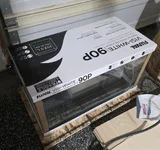
I picked up a 90P rimless, low-iron tank on a great deal.
I have a rough idea in my head for a stand to be built from plywood - just have a couple other house projects to finish off before starting that built.
Wife says I can only have one aquarium, so for this tank, I want to go all out with a sump to allow for auto top off, and auto water changes, auto fertilizer dosing etc. etc. I have half a plan in my mind.
I've also started on the light fixture which I've modeled up in CAD, and plan on making out of an 8020 extrusion, and some 3D printed bits.
I'm using bridgelux gen 3 thrive CW (3000k) and WW (5000k) LED strips which have super high CRI at 98+ along with some specific XPE2 wavelengths that I'll solder onto some starboards. Far Red (730nm), Red (654nm), Cyan (495nm), Blue (455nm), Visible UV (415nm). Each segment of the white channels will be on its own driver so I can adjust left to right brightness in thirds, and each colour channel on its own driver so I can vary each channel on a time-based approach.
These will be run from a custom PCB board with Meanwell N-LDD drivers, and will run ESPHome on an ESP32 so it can link up with my Home Assistant installation.
That's it for now, this will probably be a very slow build so be warned if you follow along!
I'm new here, but not entirely new to planted tanks though I've been out of the hobby for the better part of the last decade between kids and moving a couple of times - but finally in a spot where I can do something again. I'm mostly going to be making things up as I go along, but plan on a lot of automation (I want to integrate everything into home assistant) and a lot of DIY as I love the challenge of building things out myself.
The starting point:
I picked up a 90P rimless, low-iron tank on a great deal.
I have a rough idea in my head for a stand to be built from plywood - just have a couple other house projects to finish off before starting that built.
Wife says I can only have one aquarium, so for this tank, I want to go all out with a sump to allow for auto top off, and auto water changes, auto fertilizer dosing etc. etc. I have half a plan in my mind.
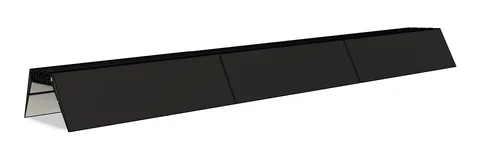
I've also started on the light fixture which I've modeled up in CAD, and plan on making out of an 8020 extrusion, and some 3D printed bits.
I'm using bridgelux gen 3 thrive CW (3000k) and WW (5000k) LED strips which have super high CRI at 98+ along with some specific XPE2 wavelengths that I'll solder onto some starboards. Far Red (730nm), Red (654nm), Cyan (495nm), Blue (455nm), Visible UV (415nm). Each segment of the white channels will be on its own driver so I can adjust left to right brightness in thirds, and each colour channel on its own driver so I can vary each channel on a time-based approach.
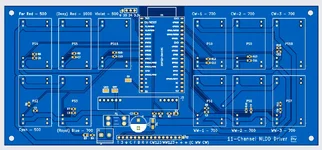
These will be run from a custom PCB board with Meanwell N-LDD drivers, and will run ESPHome on an ESP32 so it can link up with my Home Assistant installation.
That's it for now, this will probably be a very slow build so be warned if you follow along!
68 Replies
·
4539 views
Supporting
I Donated 2026
Rockstar
Browsed the Sreepadma booth at Aquashella briefly today. I'd not heard of them but they are the largest aquatic plant farm in India and have been selling their TC offerings in the US for about 2 years. I was actually impressed with the qualty I was seeing of their TC cups and wish I had room in a tank for some (and some ADA TC). Has anyone else purchased any of their plants. One of the first that I spotted was Red Tiger Crypt which was a coincidence since we have a thread discussing it.
7 Replies
·
116 views