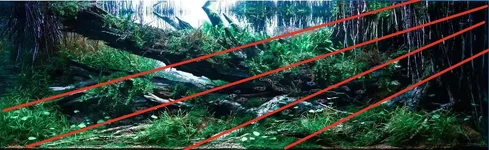
This is A River... Somewhere, the amazing IAPLC 2025 Grand Prize winning work of Josh Sim. I think this is a wonderful aquascape to use to start the Learning From Series. I hope you would agree.
The Learning From Series
I have no talent when it comes to aquascaping. If I'm honest, this is also true for almost all forms of art.... So, I am in awe of people like Josh, our friend @Jeff Miotke and @Naturescapes_Rocco, along with many others that we are privileged to count among our community. I am also so thankful that they have the talent and choose to share it with the rest of us.
The reality is that although I can't create these works of art, I can certainly appreciate them. My talents lie more in keen observation, critical thinking and curiosity. You know, stuff that will never make me a millionaire but that do come in handy when you're trying to learn something new.
As I'm in the back nine of life, I've decided that I want to take some time to appreciate and learn from aquascaping artists such as Josh. Thus, the idea for this series was born. I'm calling it the Learning From Series because that's exactly what it is. And, I'll be documenting my thought process and learnings here as a series of articles.
We are a community and sharing is part of the fun. So, I do hope you jump in and participate even if it's to tell me that I've completely missed something important. Maybe we learn together.
Finally, given that I have a day job (unfortunately, it's quite inconvenient when I'm trying to spend most of my time here), these articles will likely come in pieces. My MO is deconstructing the aquascape so that I can understand it. I'm a savor the wine type of guy rather than chug the beer.
Initial impressions of A River... Somewhere
This aquascape is multifaceted. It hits me with a lot of first impressions.
It's so real, almost biotopy. Yet, it is perfect. A lot to digest. For now though, dinner is calling. More tomorrow.
-- Update September 18, 2026
Observations continued
Amano used to say that the plants were the paint in an aquascape. I usually try to step back from the details and look at the forest, if you will. I focus on just color. This aquascape is very strongly skewed towards green. The green mostly rests on dark wood tones and black shades.
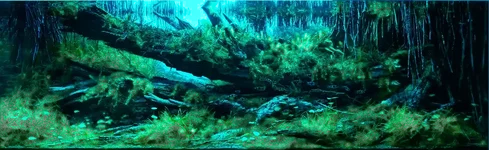
In this image above, I've blurred slightly and then punched up the greens to make them more obvious. Green is about 75% of the color, would you say?
This makes me think about focal point. Usually we are told to have a focal point in our aquascapes and this should be made quite obvious through the use of a pop of color (usually red) and/or different leaf texture or style of plant. Do you see that here?
Also, thinking compositionally again, the use of a "vanishing point" is also highly recommended. Do you see one here? I'm struggling to find it. There is certainly depth here making it seem like the river continues well beyond this image. But, how does Josh accomplish this without an obvious vanishing point?
I think his expert use of very clear foreground items versus smaller, blurred background items gives the impression of depth without needing a vanish point. This tricks our minds into thinking the things in the background a far away. This, it seems, is where details matter.
Another observation is just how natural this looks. I can truly believe that this could be a scene in "some river... somewhere." The downed tree rests very naturally and appears naturally weathered. Has a natural patina created by skillful trimming of moss and plants. Notice that the moss is not an even carpet of green. It's different shades and textures.
Nature doesn't create golf courses of green. Nature is wabi-sabi and does not favor only one species.
The hanging roots on either side also pull on my attention and constantly fight to pull me away from the center of the aquascape. There are more on the right side than on the left. Why is that? I think it will be more obvious when we analyze the composition.
Finally, what would you say is more dominant in this aquascape, if anything? Is this more plant-focused or hardscape-focused?
I will have more thoughts as I continue to deconstruct this wonderful aquascape in my mind. Again, this is really an intentional stream of consciousness, folks. And please don't misinterpret my breakdown as any sort of criticism. This is how I learn, by peeling the onion one layer at a time.
More tomorrow. Composition is next.
-- Update September 21, 2026
Composition
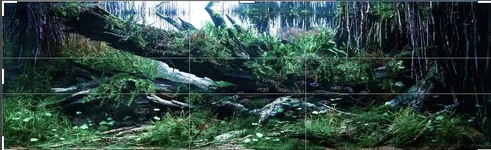
Here is the famous "golden ratio" superimposed onto the aquascape. Here are some of my initial thoughts but would love to hear what you see as well.
The idea of the golden ratio is to help you position focal points in a place that makes the overall composition seem more natural and pleasing. As you can see on the right side, the vertical line falls right on the pinky grouping of plants in the background. Interestingly, the fish grouping is also on that line. Do you think he did it on purpose?
You can also see balance by using the golden ratio. Here, the right 2/3 is definitely "fuller" or "heavy" compared to the left 1/3. I would say this aquascape is therefore "heavier" on the right side and "lighter" on the left. However, if I recall my "Amano", empty space is not necessarily lighter. Empty space can balance as much, if not more, than a completely planted area. Would you agree?
In this case, the left "emptier" side not only provides that needed empty space (called "Ma" in Japanese), but it also serves to create depth. You can see here how Josh uses the empty space to show those plants in the background that give that impression of a long distance behind the fallen tree.
Speaking of that fallen tree, it is drawing a diagonal across the entire aquascape. This creates a lower and higher triangle and again, one side is balancing the other well. Again, one is emptier with the other fuller.
Triangles are actually pleasing to our brains as it subconsciously provides a sense of order. It offers a subtle pattern that makes us comfortable. Do you think Josh knows this and has positioned that tree just so?
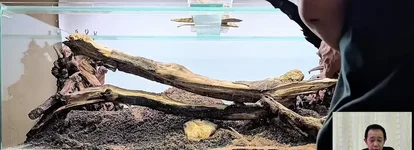
When you look at how Josh put this together, see the video linked in the posts below, it's amazing and should give you and me some hope that we too can eventually end up with something that looks great. It's hard to believe he went from the above to the final aquascape.
So, for me, the composition is the bones of the aquascape. I am trying hard to find a vanishing point and I don't see it still. I am learning that maybe this is not a requirement.
Next I will cover impressions which is really what aquascaping, and art, is about.
-- Update September 22, 2026
I probably should have started with this but better late than never. Let's talk about the impression A River... Somewhere gives you. How does it make you feel?
At the end of the day, all art should speak to its viewer. It should have something to say and evoke in the viewer a feeling. That is the goal. You are conveying something similar to telling a story.
Let's look at A River... Somewhere and just take some deep breaths and ponder what you are seeing.

To me, this aquascape conveys a very strong story. It conveys peace, impermanence, imperfection, transcendence, nature, the passing of time. I can go on an on, like peeling an onion, the more you look, the more you see.
It feels so natural, like this could really be a river somewhere in nature. Idyllic, sure, but possible. Disbelief is suspended. I can almost smell the forest.
At a deeper level, I do get that same awe feeling I get when I'm in nature. Amano used to refer to it as our souls longing for nature. BTW, if you've never read The Nature Aquarium Book 1, the descriptions are worth the price of the book.
In the end, I think Josh is a master aquascaper with a special talent for creating an idealized version of nature and capturing its very real essence. Very deserving of its ranking and I'm in awe of such talent and hard work.
Now... let's talk about our own aquariums...
Sorry, that feels like a cold bucket of water hitting you. At least for me.
Does your aquarium tell a story and inspire a feeling when you are looking at it? Does its bones (the hardscape) build an intentional composition using perspective, the golden ratio, strong focal points that work well with the overall scene?
Alas, mine most certainly does not. However, rather than lamenting it, I am inspired because it gives me a reason to re-do it. I will use more intention and the lessons gained from this little exercise. Improvement is what I'm after, not the Grand Prize at the IAPLC.
I hope you learned a nugget or two from my ramblings. At the very least, I hope you enjoyed reading along.
I'm off to find the next aquascape that I can deconstruct in the Learning From Series.
All the best, Art
Last edited: