
Welcome to ScapeCrunch

We are ScapeCrunch, the place where planted aquarium hobbyists come to build relationships and support each other. When you're tired of doom scrolling, you've found your home here.

Does the pH setting give accurate results in a Kh 0 system?

Joined
Dec 30, 2025
Messages
15
Reaction score
23
Location
TÜRKİYE
Hello everyone.

I have a question.

In KH0 systems, does a 1 pH decrease provide accuracy?

For example:

Let's say in a KH0 system, the pH of the tank water containing degassed water is 7, and with the addition of CO2, its pH drops to 6.

Let's say in a KH4 system, the pH of the tank water containing degassed water is 7.5, and with the addition of CO2, its pH drops to 6.5.

Is the CO2 released by a 1 pH decrease in KH0 equal to the CO2 released by a 1 pH decrease in KH4?

I hope I've explained it clearly.
 
There are many factors to this. If your using a nutrient rich humate soil it will suck every bit of kH out of your water. It also lowers pH so the whole kH / pH relationship is thrown out the window. Not what you wanted to hear lol.... I try and go by indicator plants to see if my CO2 is correct. Just purchased a Hanna CO2 Test Kit and dialed it in that way, which was a huge help.
 
I remember reading something on a 2 hr aquarist page about how you need a larger ph drop in very low kh tanks to acjieve 30 ppm co2.

I spent more time looking for it again than I care to mention.

Perhaps @Dennis Wong could chime in and help.
 
Hmm, but there's this:
How KH and pH work together
  • KH is a buffer: KH measures bicarbonates and carbonates, which neutralize acids, protecting pH from drastic drops or spikes.
  • High KH: More buffer, more stable pH, usually higher pH.
  • Low KH: Less buffer, pH can drop quickly (acidic), leading to stress or death for fish.
  • The Goal: Stability! A stable pH within the appropriate range for your fish is more important than hitting a specific pH number, and high KH helps achieve this stability.
From that, I was of the belief that given the same amount of CO2 injected into a 0 kh aquarium vs a 4 kh aquarium, you'd see a smaller ph drop in the 4 kh system. Is that thinking too simplistic? AI agrees with my thinking but AI isn't always right.
 
Normally when you add an acid to an aquarium available KH neutralizes the acid and in the process KH is reduced.

Co2 in the system makes carbonic acid which lowers PH, but, is not neutralized by KH.
 
Honestly, I’m completely stuck at this point.
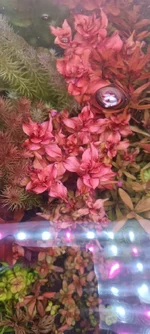
If I target a 1.3 pH drop, the plants get worse.
If I target a 2.0 pH drop, the plants look much better.


I already have a chlorosis issue that I haven’t been able to solve for two years.
In variegated plants, the veins gradually disappear and become blurred.


I’ve started to suspect that this might actually be a CO₂ distribution problem.


This is how I measure it:
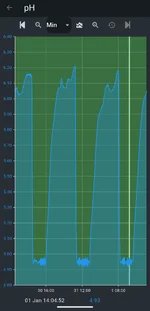
I take 100 ml of tank water and stir it with a magnetic stirrer for 30 minutes.
After degassing, the pH reads 7.2.
When I measure the tank directly, the pH is around 5.3.
The CO₂ indicator turns yellow.
 
Probably low micros if at the top of the plant. What chelate are your micros?
Now I’ll list all my parameters.


GH-based values:
Ca 5 ppm
Mg 2 ppm


Macronutrients (weekly):
NO₃ 4.43 ppm
PO₄ 0.75 ppm
K 0.55 ppm


Iron:
Fe EDTA 0.02 ppm
Fe DTPA 0.01 ppm
Total Fe 0.03 ppm


Micronutrients:
Fe 0.025 ppm
Mn 0.0071 ppm
Zn 0.0036 ppm
B 0.0026 ppm
Cu 0.0037 ppm
Mo 0.0001 ppm


pH 5.3
TDS 25 ppm


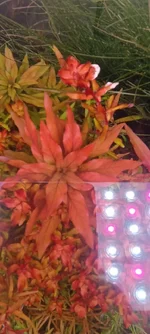
Red plants turn extremely red, so there is no issue on that side.
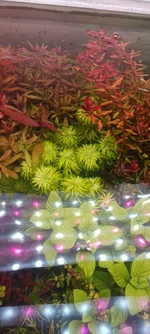
However, green plants never become dark green; there is always a chlorosis problem.


For example:


  • Rotala macrandra variegated → veins are pale and blurred
  • Lindernia india → veins are pale

Another thing I noticed:
Eriocaulon cinerium propagates and splits regularly, but it has never produced seeds in my tank.
When I give the same plant to others, it produces seeds almost immediately.


What I’ve already tried:


  • I tested all iron chelates
  • Fe gluconate (it intensified red colors but had no effect on green plants)
  • Increased PO₄ → no effect
  • Raised Mg to 4–5 ppm → no effect
  • Tested Ca:Mg ratio of 3:1 (15 ppm Ca / 5 ppm Mg) → no effect
  • When I reduce CO₂, Rhizoclonium algae increases
 
Now I’ll list all my parameters.


GH-based values:
Ca 5 ppm
Mg 2 ppm


Macronutrients (weekly):
NO₃ 4.43 ppm
PO₄ 0.75 ppm
K 0.55 ppm


Iron:
Fe EDTA 0.02 ppm
Fe DTPA 0.01 ppm
Total Fe 0.03 ppm


Micronutrients:
Fe 0.025 ppm
Mn 0.0071 ppm
Zn 0.0036 ppm
B 0.0026 ppm
Cu 0.0037 ppm
Mo 0.0001 ppm


pH 5.3
TDS 25 ppm


Red plants turn extremely red, so there is no issue on that side.
However, green plants never become dark green; there is always a chlorosis problem.


For example:


  • Rotala macrandra variegated → veins are pale and blurred
  • Lindernia india → veins are pale

Another thing I noticed:
Eriocaulon cinerium propagates and splits regularly, but it has never produced seeds in my tank.
When I give the same plant to others, it produces seeds almost immediately.


What I’ve already tried:


  • I tested all iron chelates
  • Fe gluconate (it intensified red colors but had no effect on green plants)
  • Increased PO₄ → no effect
  • Raised Mg to 4–5 ppm → no effect
  • Tested Ca:Mg ratio of 3:1 (15 ppm Ca / 5 ppm Mg) → no effect
  • When I reduce CO₂, Rhizoclonium algae increases
From my perspective, and strategy, you look low in several areas. I dose the same whether inert substrate or AS. Keeping nutrients razor low may boost reds in a very limited number of plants, but is never worth risking deteriorating plant health when the levels dip below what's required.

Ca/Mg is way low. I keep my Ca at 32ppm, Mg 8ppm. Your GH is just over 1 degree! I'd say 4dGH minimum and 6 to 7 optimal.

I know EU people have a low nutrient philosophy, but K should be higher than NO3 and I agree with @Burr740, .45Fe weekly is the sweet spot. I would raise everything personally. That said, us Americans oversize everything. I'd also get a Hanna CO2 test kit, just remove the guessing and see what Co2 levels you have.
 
Several nice comments here. Maybe others who follow a lean dosing method maybe able to comment.
My 2 cents is completely based out of my experience with APT 3 and following Dennis's work, so take that with a pinch of salt. But i do follow lean dosing.

First,
I had Chat GPT compare your dosing to recommended APT 3 and i got

Relative to APT 3 weekly:
  • NO₃: ~59% of APT 3
  • PO₄: ~26%
  • K: ~3% (this is the glaring one)
  • Fe: ~14%
Not sure what your measured nitrates are. To give a buffer against under-dosing i would recommend to have Nitrates somewhere between 0.5 - 2. You might want to consider increasing potassium and iron.

Second:
Shooting for a GH close to 5-6 seems to work best for most plants. The TDS of 25 seems quite low. I have a KH of 2-3 and a GH of 5-6 and my TDS is consistently close to 80. (With the caveats that TDS just does not reflect these).

I think if you plan on switching to EI there are several expert posts above me, but i would anticipate a period of turbulence prior to stability if you go down that route from this very lean route. If you plan to stick to the lean dosing, i would do 1 step at a time of increasing nitrate (based on measurement), Potassium, Iron, Ca/Mg
 
This is another interesting point.
It suggests that my chlorosis problem is not caused by excessive CO₂. :)
Nothing is ever caused by excessive CO2 besides dead fish! ;)
90% of aquarium plants evolved to grow emersed as well as submerged, in our atmosphere that has 400ppm CO2 (and rising). Certainly not chlorosis!

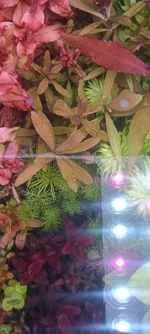
Your plants don't look too bad. I agree with Unexpected, maybe a bit more Mg (some chlorosis can happen from low Mg). But you're not far off, those plants aren't suffering!

Also for anyone reading, I've run many pH profile tests with my GHL Aquarium computer and very expensive pH probe, and let me tell ya, pH readings are really inaccurate for CO2 levels.

I know I've spammed it all across this forum, but the Hanna CO2 titration test kit should be considered a no brainer for every aquascaper. It's by far the most reliable, easy, and reputable way to measure CO2 levels!
 
Your plants don't look too bad. I agree with Unexpected, maybe a bit more Mg (some chlorosis can happen from low Mg). But you're not far off, those plants aren't suffering!
I'm glad you said this, because when I look at those photos, my thought is I would be happy with those plants in my aquarium. 😁
 
This is another interesting point.
It suggests that my chlorosis problem is not caused by excessive CO₂. :)

Ive often seen a point where too high co2 starts to bring negative returns and actually cause issues. (careful who you say that around! lol) But this isnt that. Your chlorosis problem is low macros

Red plants turn extremely red, so there is no issue on that side.
However, green plants never become dark green; there is always a chlorosis problem.
Your stems are starving for macros. Id get K up at least even with NO3 and then double them all. Whatever your dosing now for macros, double it. Micros are fine where they are but if you have to raise them too to get the macros do it

I didnt catch your soil's age but it might be running out of its nutrients. That slips up on people especially low dosing folks

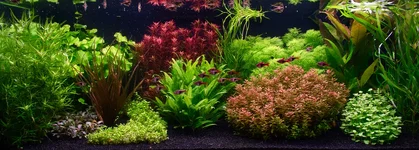
Its not just greens that look bad. Your Rotalas are all pale except the deep red group and its half stunted. The Lisimachia (Samolus Red) is trying to grow in stem form instead of rosette. It does that when it's not getting enough macros

I could be wrong so apologies if I misjudge here, but the fact that "reds turning red" is a top concern for you makes me suspect you may have the wrong idea/approach for growing healthy plants to begin with. It sounds (and looks) like youre really holding back on water column ferts for fear of plants losing color? That is not gonna happen. Ive never had anybody say my plants arent red or colorful enough?

Its always best to grow the plants healthy first then start reducing ferts if you think you need more color (you wont). Unless your soil is newer than about 6 months, that means plenty of macros in the water. Then see if anything needs to be "redder". Spoiler alert: The answer will be NO! Hah
 
Ive often seen a point where too high co2 starts to bring negative returns and actually cause issues
Hi Joe,
I've wondered before about this. Apart from fish health, what negatives might you expect to see with C02 being too high?
 

Top 10 Trending Threads

Back
Top