Welcome to ScapeCrunch

We are ScapeCrunch, the place where planted aquarium hobbyists come to build relationships and support each other. When you're tired of doom scrolling, you've found your home here.

Finally getting my CO₂ curve where I want it on my UNS 60U

Joined
Sep 29, 2026
Messages
11
Reaction score
21
Location
Los Angeles
66622.webp
66633.webp

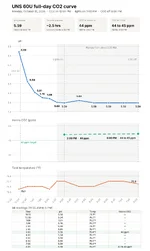
I recently added a small adjustable powerhead/wavemaker that's set to constant flow mode to increase surface agitation, gas exchange, and overall circulation. The goal wasn't to reduce CO₂, but to use stronger gas exchange along with adequate injection to get CO₂ up quickly before lights-on and then reach a stable equilibrium instead of continuing to accumulate throughout the photoperiod

Big thanks to @Dennis Wong / 2Hr Aquarist for his articles explaining this approach. I've learned so much from them. It's completely changed how I look at CO₂ injection and surface agitation

For testing I'm using a freshly calibrated Apera PH60 for pH, Hanna Checktemp 1 for temperature, and the Hanna HI3818 CO₂ titration kit to check actual CO₂ concentration. CO₂ kicked on at 12 PM, lights came on at 3 PM, and CO₂ shut off at 8 PM

Tank/water parameters: UNS 60U, Controsoil, RO/DI remineralized with APT Sky, GH 5 to 6, KH 0. My best degassed pH reference is around 7.30, so I'm seeing roughly a 1.7 pH drop at plateau. With 0 KH the standard pH/KH chart doesn't apply, so I'm using the Hanna kit alongside pH to track the curve

Today's testing showed a really good trend. The tank was already at pH 5.60 by 2:30 PM, reached 5.59 at lights-on, and stayed essentially flat through 8 PM. Hanna measured approximately 44 ppm at lights-on and 44 to 45 ppm at the end of the injection period. Since I was essentially at plateau 30 minutes before lights-on, I now feel comfortable reducing my pre-light injection from 3 hours to 2½ hours and seeing if I can still reach the same level by lights-on

My original CO₂ target was around 40 ppm, but at this point I'm wondering if it's worth trying to make a microscopic needle-valve adjustment just to knock off ~4 ppm when the curve is this stable

Would you guys leave it around 44 ppm or bring it down slightly closer to 40?

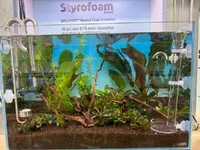
There's no livestock yet, so I'm taking advantage of this time to get everything dialed in. Plants are doing great. Planned livestock is cardinal tetras, pygmy cories, Amano shrimp, and eventually Caridina, and I'm planning to start stoc
king next week
 
View attachment 20826
View attachment 20827

I recently added a small adjustable powerhead/wavemaker that's set to constant flow mode to increase surface agitation, gas exchange, and overall circulation. The goal wasn't to reduce CO₂, but to use stronger gas exchange along with adequate injection to get CO₂ up quickly before lights-on and then reach a stable equilibrium instead of continuing to accumulate throughout the photoperiod

Big thanks to @Dennis Wong / 2Hr Aquarist for his articles explaining this approach. I've learned so much from them. It's completely changed how I look at CO₂ injection and surface agitation

For testing I'm using a freshly calibrated Apera PH60 for pH, Hanna Checktemp 1 for temperature, and the Hanna HI3818 CO₂ titration kit to check actual CO₂ concentration. CO₂ kicked on at 12 PM, lights came on at 3 PM, and CO₂ shut off at 8 PM

Tank/water parameters: UNS 60U, Controsoil, RO/DI remineralized with APT Sky, GH 5 to 6, KH 0. My best degassed pH reference is around 7.30, so I'm seeing roughly a 1.7 pH drop at plateau. With 0 KH the standard pH/KH chart doesn't apply, so I'm using the Hanna kit alongside pH to track the curve

Today's testing showed a really good trend. The tank was already at pH 5.60 by 2:30 PM, reached 5.59 at lights-on, and stayed essentially flat through 8 PM. Hanna measured approximately 44 ppm at lights-on and 44 to 45 ppm at the end of the injection period. Since I was essentially at plateau 30 minutes before lights-on, I now feel comfortable reducing my pre-light injection from 3 hours to 2½ hours and seeing if I can still reach the same level by lights-on

My original CO₂ target was around 40 ppm, but at this point I'm wondering if it's worth trying to make a microscopic needle-valve adjustment just to knock off ~4 ppm when the curve is this stable

Would you guys leave it around 44 ppm or bring it down slightly closer to 40?

There's no livestock yet, so I'm taking advantage of this time to get everything dialed in. Plants are doing great. Planned livestock is cardinal tetras, pygmy cories, Amano shrimp, and eventually Caridina, and I'm planning to start stoc
king next week

at KH0, the Hanna kit slightly overestimates the ppm CO2. If it reads 44ppm at 0dKH, you probably have 39-40ppm CO2. Which, with plenty of surface agitation and lack of surface scum, is perfect for high-energy tanks IMO!
 
at KH0, the Hanna kit slightly overestimates the ppm CO2. If it reads 44ppm at 0dKH, you probably have 39-40ppm CO2. Which, with plenty of surface agitation and lack of surface scum, is perfect for high-energy tanks IMO!
Thanks Rocco! I actually remember you mentioning in another thread that you compared the Hanna kit against an OxyGuard and found it read about 5–10 ppm high at 0 KH. Was that based on multiple side-by-side tests at 0 KH? If so, that would potentially put my 44 ppm Hanna reading closer to the high 30s, which is pretty much where I was originally trying to land. My only concern with the livestock I've listed is the caridinas. Any input on that aswell?
 
Thanks Rocco! I actually remember you mentioning in another thread that you compared the Hanna kit against an OxyGuard and found it read about 5–10 ppm high at 0 KH. Was that based on multiple side-by-side tests at 0 KH?
Yeah, I tested at 0KH, 2KH, and 4KH I believe. I'll have to check my notes, but the Hanna kit overestimated every time compared to the membrane-reading of the Oxyguard, which is independent of water chemistry. Still highly recommend the Hanna kit, as long as we know the limitations and work with them!
If so, that would potentially put my 44 ppm Hanna reading closer to the high 30s, which is pretty much where I was originally trying to land. My only concern with the livestock I've listed is the caridinas. Any input on that aswell?
I've only kept caridina in low tech, 0dKH, but it should be fine. Dennis Wong keeps caridina in many tanks that are CO2 injected to 30-40ppm+, but they all have high surface agitation to keep oxygen high. My thoughts are your shrimp should be fine, just make sure there is lots of O2 in the water separately from CO2 via high surface agitation (and surface skimming of some kind)!
 
Yeah, I tested at 0KH, 2KH, and 4KH I believe. I'll have to check my notes, but the Hanna kit overestimated every time compared to the membrane-reading of the Oxyguard, which is independent of water chemistry. Still highly recommend the Hanna kit, as long as we know the limitations and work with them!

I've only kept caridina in low tech, 0dKH, but it should be fine. Dennis Wong keeps caridina in many tanks that are CO2 injected to 30-40ppm+, but they all have high surface agitation to keep oxygen high. My thoughts are your shrimp should be fine, just make sure there is lots of O2 in the water separately from CO2 via high surface agitation (and surface skimming of some kind)!
Thanks Rocco, that's really helpful, especially knowing it overestimated consistently across 0, 2, and 4 KH. That makes me a lot more comfortable that I'm sitting right around 40.

Good to hear on the Caridina too. I've got strong surface agitation from the wavemaker and lily pipe plus a surface skimmer on a timer. I also run a neo air diffuser opposite schedule of the lighting period, so oxygen should be in good shape.

One question on the Hanna since you've tested it a lot. I've been getting some variation between tests on the same water. When you ran yours, did you measure the sample with a syringe or go by the line on the cup, and did you add titrant strictly drop by drop?
 
Thanks Rocco, that's really helpful, especially knowing it overestimated consistently across 0, 2, and 4 KH. That makes me a lot more comfortable that I'm sitting right around 40.

Good to hear on the Caridina too. I've got strong surface agitation from the wavemaker and lily pipe plus a surface skimmer on a timer. I also run a neo air diffuser opposite schedule of the lighting period, so oxygen should be in good shape.

One question on the Hanna since you've tested it a lot. I've been getting some variation between tests on the same water. When you ran yours, did you measure the sample with a syringe or go by the line on the cup, and did you add titrant strictly drop by drop?
I always use syringes for accurate measurement, habit from my biochemistry days!
1791999008441.webp
So I always add 10mL of tank water via syringe to the cup, then add the titrant dropwise. Aim for a light pink.

Remember, titrations are always somewhat inaccurate, and that's ok. The difference between 40ppm and 45ppm CO2 in your tank doesn't matter much; what matters the most is having enough CO2 saturated in your water by the time the lights come on, and maintaining that concentration throughout the bulk of the photoperiod. The Hanna kit is just a good way to get a general sense of this. I highly recommend combining Hanna co2 measurements with pH readings/pH drops, and a properly placed Drop Checker too!
 
I always use syringes for accurate measurement, habit from my biochemistry days!
View attachment 20848
So I always add 10mL of tank water via syringe to the cup, then add the titrant dropwise. Aim for a light pink.

Remember, titrations are always somewhat inaccurate, and that's ok. The difference between 40ppm and 45ppm CO2 in your tank doesn't matter much; what matters the most is having enough CO2 saturated in your water by the time the lights come on, and maintaining that concentration throughout the bulk of the photoperiod. The Hanna kit is just a good way to get a general sense of this. I highly recommend combining Hanna co2 measurements with pH readings/pH drops, and a properly placed Drop Checker too!
That actually helps a lot. I recently switched from measuring the sample with a syringe to using the line on the cup, and I noticed the cup line gives me slightly less water than measuring 10 mL with the syringe. I've also been adding the first portion of titrant a little faster and only going drop by drop once I get close to the endpoint. The light pink throws me off though. There's a point where it looks very very faint pink and still a light pink but more visible. I usually stop right at the very very light pink change. Which I hope is correct.

I'm going to switch back to measuring exactly 10 mL with the syringe and do the titrant drop by drop the whole way like you do. That could explain some of the inconsistent readings I've been getting lately.

And I agree, I'm probably splitting hairs worrying about 40 vs 45 ppm 😂. My pH has been basically flat from lights on to lights off, so I'm happy with where the CO2 is now.
 
I think it sounds like you already know, and understand, more about CO2 stability and injection than 95% of hobbyists out there lol. You get it dialed in and at those ppms, you'll be able to grow ANY plant!
Haha appreciate that man! I've definitely gone down the CO2 rabbit hole these last few weeks 😂. But I feel like I finally have a good understanding on the relationship between injection, gas exchange, circulation and stability instead of just chasing a certain pH drop, relying on an indicator bulb or ppm number. Now I'm ready to start enjoying the tank 😂. Thanks again for all the help!
 
Just an fyi - I spoke with Grant Eder about co2 with caridina when I was starting my three caridina tanks and he said the caridina wouldn’t have a problem with co2 but could have a problem with the daily swings in ph. I just keep mine on full time and they are doing fine so far.
 

Top 10 Trending Threads

Back
Top