Welcome to ScapeCrunch

We are ScapeCrunch, the place where planted aquarium hobbyists come to build relationships and support each other. When you're tired of doom scrolling, you've found your home here.

The Great Big Filter Thread

  • Thread starter Thread starter JayP
  • Start date Start date
  • Tagged users Tagged users None

JayP

Valuable Member

Joined
Jul 13, 2025
Messages
1,219
Reaction score
1,994
Location
Raymore, MO United States
There are several threads discussing the new Aquael Hypermax 4500BT. I'm sure many would like some reports on it's performance over time. We have a thread discussing nano canister filters. We're all waiting for one of @Naturescapes_Rocco in depth write-ups discussing his filtration set-up. @Pepere and @*Ci* have unique set-ups as well, @Kwyet has used a matten filter, and we have several other members running sumps. That doesn't even include all those running sponge and HOB filters.

The idea is that we can consolidate a lot of filter information in one place making it easier to find rather than searching through so many threads. Maybe this won't work but I thought it was worth giving it a try. Perhaps it may be better listed as an article at some point.

I'm going to get things started by discussing factors I feel are most important to me when choosing a filter.

1) Filtration Performance: This goes without saying. The filter’s primary job is to keep our water clean and free of anything that harms the inhabitants. Of course, there are multiple factors that play into this. Some say flow is most critical, while others claim media volume is most important. Are there other factors? I still have limited experience, but my view, having done considerable reading, is that flow tends to be a bit overblown. You’ll see recommendations of anywhere from 4 to 10 times turnover rate with most leaning toward the higher end of that. I don’t think turnover rate is really the detail to be concerned about, at least with heavily planted tanks like are the norm here. I think the focus should be simply on ensuring flow achieves the goal of effectively moving water through the system to remove toxins/waste, delivering nutrients, and aiding gas (oxygen/CO2) transfer. If a turnover rate of 3 or 4 does that without dead spots in the tank, you should be good. After all, most of us here are plant focused and therefore, the fish we generally have are smaller community species that typically don’t care for high flow (there are, of course, exceptions).

I think there’s a simpler answer regarding media volume; more is better. Obviously, there must be a balance between internal volume and overall size of the filter. Real estate in and around our aquarium stands is precious. Filters like the Fluval FX6 and the newest Aquael Hypermax are huge. If you’re going for one of those, you’re likely putting it on a large tank with plenty of space underneath but again, it’s a matter of finding the right balance that provides the performance you need in a manageable size.

2) Reliability/Durability: This is where solid reviews come in handy and why getting feedback from users here is invaluable. Filtration performance becomes moot if the filter isn’t running, or worse yet, just flooded your house. Being able to easily source spare parts is also valuable, which is why sticking to the top well-known brands is often a safe route. It’s also why many aquarists place canister filters in protective containers, something else to consider when taking into account, size of filter. (this is something I should really do as I’ve had to clean up a few significant spills after filter maintenance and not getting the top secured in place properly 😲 )

3) Tie – Maintenance/Noise Level: These two factors are equally important to me. If the filter is a pain to maintain, I’m going to put it off, and that’s bad. It affects the performance. But equally important to me is how noisy it is. I tend to be sensitive to annoying little sounds regardless of where I am; at home, in the car, at work, you name it. If the aquarium is in a part of the house I spend a lot of time in, well then, it’s even more important.
I don’t know if Oase was first to do it, but the idea of the prefilter was, I think, a game changer for many. I imagine it was derived from people installing foam filters on the intake pipes. Having an easily removable section with foam filters that catch a lot of large particles before entering the primary filter chamber is a great idea, resulting in expanded intervals between main filter head removals for cleaning.
Another aspect of maintenance is ease of priming. This could also be an aspect of performance but I don’t think it is quite as important. I’m not sure there is a canister filter that is truly or consistently easy to prime. Some may start out that way, but over time, become less and less so. This is an area I’d really like to see product designers put more serious thought. My experience so far is with Oase and the Fluval 07 series. Hated the Fuval priming and I’m just so-so with the Oase. Let me know your experience with priming other brands.

As for noise, I don’t mind the slight hum of an impeller as long as it’s steady and consistent, much the same way some people, including myself when I was younger, like the smooth steady sound of a fan at night to help them sleep. It’s when the sound becomes inconsistent, I’m bothered. I also don’t care for the sound of splashing/trickling water while I’m focused on other things. Only when I’m camping near the banks of a creek or other body of water is this OK 😊. This is one of the main reasons I’m not a fan of HOB filters. I’m also tweaking my CO2 reactor designs to minimize the bubble sounds of CO2 entering the reactor.

4) Cost: Let’s be clear, the cost doesn’t stop when you pay the retail price for the filter. There’s the cost of media and spare parts plus the cost of electricity. What’s the rated wattage of the filter. I see the Aquael filters claim to consume lower power and are therefore cheaper to run. What about special filter cartridges or foam. Is it easy to cut foam filters from inexpensive bulk material? How often are gasket replacements necessary, or are there common issues with parts failing over time. Of two Fluval 07 filters I’ve used, both needed replacement impeller shafts. Oase Biomaster filters seem to have an issue with the input/output head often needing replaced.
I admit cost isn’t a critical factor for me, but I know it is for many others, so this is another instance where finding the right balance is key, in this case, the balance between price and performance.

Share your thoughts. Do these factors seem to align with yours or do you think I’m way off base. Tell us what types and brands of filters you prefer and why.


 
The filters I have the most experience with are the Oase Biomasters.

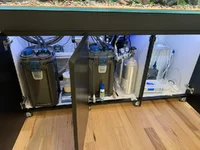
They're a bit on the expensive side, but the prefilter concept was revolutionary when it released. However, they're a bit noisy (much of this was fixed with the Version 2 release), and woefully underpowered. Most larger tanks will need 2 biomasters for full proper circulation:
1775708172057.webp
My 140gal needed two Oase Biomaster 850s. Two of these filters = $720 alone, just to get the flow rates needed. They're OK quiet, but the prefilter was great.


Also, I believe 75% of people in this hobby don't understand the point of prefilters and foam density options. It makes no sense to use coarse foam as your prefilter sponge; the entire point of a prefilter is to catch the vast majority of physical particles from the water and keep them stuck in the foam for YOU to clean it out. When set up properly a prefilter should need to be cleaned every 2-4 weeks to keep flow rates proper. With a setup like this, your main sponges/bio media won't need cleaning much, if ever.

Prefilters are like underwear; they're MEANT to be changed frequently, to do the heavy lifting, so you don't have to wash your jeans every day. Let the prefilters get dirty, it's their job. Use the 60PPI sponges if it's an Oase Biomaster.

I still keep two biomasters as backup/quarantine tank filters if ever needed!


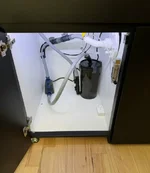
About 1.5 years ago I switched all of my tanks to using a DIY filtration setup using the Netlea prefilters and inline Oase pumps:
1775708287594.webp
My initial setup was literally just intake lily pipe > Netlea Prefilter > Inline Pump > CO2 reactor > Return Lily Pipe. No bio media, only the dense ~60ppi netlea sponge.

It worked great:


Cost is ~$90 for the prefilter, $120 for the pump. $210 total, less than 1/3rd the cost of two biomasters.

In my rough measurements, with this setup I was getting MUCH more flow than with two Biomaster 850s COMBINED. In fact, I had to turn the flow down significantly via valves, or this tank became a hillstream setup very quickly. The prefilter canisters have built in quick disconnects with valves, so you can simply remove the entire prefilter from the cabinet, carry to your sink drip-free, and aggressively clean the sponge out.

1775708575753.webp
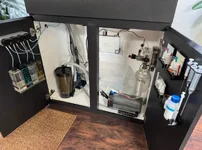
(old photo) I even use an empty sideways Netlea Prefilter as a Horizontal CO2 reactor with great success!

In a more recent experiment, I upgraded all the prefilters to the Large size, and filled one with nothing but biomedia:
1775708744335.webp

With this setup, you get ~6L of easy-removed dense prefilter sponge, then NINE LITERS (9L) of bio media capacity in the second prefilter housing, then an even larger horizontal reactor from a sideways prefilter. All 3 of these parts are easy to disconnect, remove from the cabinet, clean/adjust/replace, and not make a mess. It's amazing, that's all I can say. I don't know why this kind of setup hasn't been made more popular before; I will literally never go back to regular canister filters!

It's cheaper, easier to maintain and clean, modular (for replacements and customization), and infinitely flexible for whatever your setup is. You can choose a pump of your desired price/power, use one or two or three prefilters, and all of them can be quickly removed without spilling water anywhere from the cabinet, cleaned/adjusted, and replaced.

For example, I can quickly remove the "bio media" canister filter, scoop half of the bacteria-rich media out for use in a new tank's empty filter, and replace it with new media -- all in about 5 minutes, no tools, no leaks, leaving all of the existing plumbing in place. Cheaper, more effective, etc.

One of these Large Prefilters, for $90, when filled to the max 9L+, can hold more media than a $400 Biomaster 850!

A video would do this more justice... some day!
 
Prefilters are like underwear; they're MEANT to be changed frequently, to do the heavy lifting, so you don't have to wash your jeans every day
See, I already learned something new, change underwear frequently. :LOL:

Seriousely though, I did forget the #5 ranked thing on my list above;
5) Extra Features: Oase filters have the built-in heater which I find very appealing since I want to keep as much equipment out of the tank as possible and if going the inline heater route, that's another thing to restrict flow.
Some Eheim and Aquael filters now have bluetooth and app control. I find the idea of throttling the filters impeller speed to affect flow and programming flow based on time of day, intriguing, and am anxious to hear what users think of it.
 
I have had sponge filters, Matten filters, Fluval 407’s and fx’s, Oase Biomasters and Filtosmarts, various HOB’s, and various internal submersibles.

I like the Pennplax Cascade 170 submersible and the Nicrew submersible with spray bar for small tanks when I want sonething that will work easily with an Open Flow reactor, or I just want to keep things cheap until switching to a filterless tank. I always cycle with a filter first and let the tank have some time to mature before going filterless.

I don’t like sponge filters very much because they’re ugly and they take up too much space, but they’re cheap, easy to hide in the back of a larger planted tank in case I want to cycle a small tank or bucket quickly, and very safe for shrimp and fry.

I don’t like HOB’s very much either, but again, they’re fairly cheap and maintenance is easy. I like the Seachem Tidals the best out of the HOBs I’ve used. They have good flow and a built-in skimmer, and relatively have a lot of space for media.

I’ve used a Matten filter with an air pump for a shrimp tank, and it was safe for shrimp, but only marginal as a filter, meaning it was hard to keep the tank clean. I’m currently using a corner Matten Filter with an fx6 for the Hillstream tank, and that works very well. I have cut through it close to the substrate so it’s fairly easy to take out and clean. It’s very safe for the loaches and shrimp, and I drip the ferts (or anything else I want to add) into that area so it flows through the filter first and gets mixed very well.

The Fluval 407’s have held up well for me for many years. I broke one in the move, but the other is still going strong. They’re easy to prime, quiet, and have decent flow for what they are. I guess one downside of any Fluval filter is the ugly hoses and pipes, so there’s the added expense of replacing those with something nicer if they’re going to be visible.

The Oase Filtosmarts Thermo’s work well for me in small/medium tanks. Like the Biomasters, the heater is incorporated into the filter, which is convenient. They’re handy for smaller spaces. I have to use pliers to turn the dial on top and get them open though. Their included pipes are ugly too.

The Oase Biomaster…I loved them, then I hated them, and now I tolerate them. The prefilters are only easy if you have the overhead space to pull the long housing out without completely removing the filter from the aquarium stand, but yes it’s a good feature. It’s also nice to have the heater incorporated. Previously mine were very noisy (and that’s saying something because the hillstream tank covers most noises with its running water sound), extremely difficult to prime, and very easy to get air-locked, plus the flow is weak for the price. After punching lots of holes in the prefilter internal tube and leaving several internal media containers empty (and I do use coarse foam for better flow), and buying new, improved underplates, a lot of these problems are much improved. Air is still purged but they aren’t so noisy. I haven’t had any problems air-locking, and priming is fairly easy. Flow is just adequate. Here’s the thing though, I really think if the filter was designed badly and had to be improved to work decently, then Oase should have provided those upgrades for free. Maybe I’m alone in that. I call it standing behind your product!

I like the Fluval fx’s the best of all of the filters I’ve tried, although they aren’t suitable for every situation. They have best flow, the best interior space, and the best design. They purge air twice a day, and that’s it. There are some drawbacks though. The 1 inch tubing can be hard to match up with other equipment. Luckily Aquarocks Colorado has tubing, pipes, and reactors to fit. I don’t know of an inline heater that fits though. Finding double taps is difficult and expensive. I also can’t turn the locks on the tubing attachments without pliers. And, it’s huge, so measure first to make sure it even fits under your stand.

Sometime in the future, I want to try a set-up like @Naturescapes_Rocco. Right now I have a Biomaster 600 and a Fluval 407, supplemented by a powerhead, on the 140g tank that I recently bought from him. It’s okay for now, but it’s a deep tank and I think could use a little more power for better circulation, plus longer lily pipes. The old ones look silly now, lol!
 
I'd like to understand better the benefits of Rocco's inline pump and prefilter setup over a simple liftable canister filter like an Eheim Classic. With quick disconnect valves they seem equally easy to disconnect and take away the "body" of the filter for cleaning (Even the largest Eheim CLassic is reasonably carryable even full with water. THe only obvious difference would seem to be having a choice of pump rating by having a separate pump and potentially extra flow compared to the inbuilt pump of a simple canister filter. What am I missing here ?

Talking specifically about filters for reasonably large tanks, I have already mentioned Eheim Classic. I am a huge fan of them and I have been using them since the 1980's. Its the simplicity and sheer reliability of them that appeals to me. In all those years I have never had a critical leak (in fact barely any leakages at all) and I still run 3 of them. THe design of the sealing system seems almost foolproof, so long as one lubricates the gasket each time with a quick smear of silicon grease. I also expect to get decades out of a Classic, rather than just years. The occasional new impeller and shaft every few years is all they need. I simply don't see a need to change. I've tried a few others including an FX6, but realised I preferred having multiple smaller canisters for a larger tank rather than having one monster canister. Each individual smaller filter is easier to maintain and lighter to carry.
In fact whatever the style of filter I am using, I am a great fan of multiple smaller filters for any tank rather than one larger filter. I find having multiple outflows allows a much more even, spread out flow in a tank compared to a single higher flow outlet. How anyone puts up with single outlets putting out 2000 plus lph in a tank smaller than around 200 gallons I don't know. With multiple filters one also gets redundancy built in. So, a failure of one filter rarely affects a tank too drastically, as the others cover the workload. Even with all my shrimp tanks I have multiple sponge filters for all the same reasons. Having multiple filters running in all tanks also always makes a spare mature cycled filter available at all times for a new tank.

Key aspects for filtration for me would fit in with the categories mentioned above, and are.......

1/ Reliability/longevity
2/ Ease of cleaning/maintenance
3/Noise (all my tanks are in my living space)
4/ Cost

Its impossible to put an order of importance because they are all important factors. I don't mention "Extra features" in a filter, as they are actually a turn off for me. I'd far rather keep them separate, and I have no interest in adding any bluetooth or online control.

As for milter media, I run 20-30 ppi sponge as the media in all filters at all times. I have become more and more convinced that it is absolutely as effective as any "biomedia" available, is so easy to clean out, and simply acts as an excellent all-in-one filter medium.
In fact in my last big filtration change in my big display tank I swapped out 20 plus litres of Seachem Matrix in phases for the same volume of 20 ppi sponge and within a couple of months the nitrates bizarrely dropped from around 25 to 10 ppm in the tank (stable and consistent). THis was a tank with no plants in and a high fish load. Nothing else was changed. The drop in nitrates was unexplainable to me, but was a real thing.

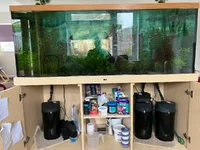
Its not the laboratory-grade type of installation that I know a lot of you guys have but here's the setup on my 150g. There's a Yugang reactor out of picture on the side of the cabinet on one of the filter outflows. Each canister needs the sponge media inside cleaning out around every 2 months and I find each individual filter still portable enough to not make this task a difficult one. Scruffy but it works well for me. THe filters have been working in this basic configuration on this individual tank for at least 15 years, through all sorts of evolutions of the tankitself.

IMG_7131.webp
 
The filters I have the most experience with are the Oase Biomasters.

They're a bit on the expensive side, but the prefilter concept was revolutionary when it released. However, they're a bit noisy (much of this was fixed with the Version 2 release), and woefully underpowered. Most larger tanks will need 2 biomasters for full proper circulation:
View attachment 15946
My 140gal needed two Oase Biomaster 850s. Two of these filters = $720 alone, just to get the flow rates needed. They're OK quiet, but the prefilter was great.


Also, I believe 75% of people in this hobby don't understand the point of prefilters and foam density options. It makes no sense to use coarse foam as your prefilter sponge; the entire point of a prefilter is to catch the vast majority of physical particles from the water and keep them stuck in the foam for YOU to clean it out. When set up properly a prefilter should need to be cleaned every 2-4 weeks to keep flow rates proper. With a setup like this, your main sponges/bio media won't need cleaning much, if ever.

Prefilters are like underwear; they're MEANT to be changed frequently, to do the heavy lifting, so you don't have to wash your jeans every day. Let the prefilters get dirty, it's their job. Use the 60PPI sponges if it's an Oase Biomaster.

I still keep two biomasters as backup/quarantine tank filters if ever needed!


About 1.5 years ago I switched all of my tanks to using a DIY filtration setup using the Netlea prefilters and inline Oase pumps:
View attachment 15947
My initial setup was literally just intake lily pipe > Netlea Prefilter > Inline Pump > CO2 reactor > Return Lily Pipe. No bio media, only the dense ~60ppi netlea sponge.

It worked great:


Cost is ~$90 for the prefilter, $120 for the pump. $210 total, less than 1/3rd the cost of two biomasters.

In my rough measurements, with this setup I was getting MUCH more flow than with two Biomaster 850s COMBINED. In fact, I had to turn the flow down significantly via valves, or this tank became a hillstream setup very quickly. The prefilter canisters have built in quick disconnects with valves, so you can simply remove the entire prefilter from the cabinet, carry to your sink drip-free, and aggressively clean the sponge out.

View attachment 15948
(old photo) I even use an empty sideways Netlea Prefilter as a Horizontal CO2 reactor with great success!

In a more recent experiment, I upgraded all the prefilters to the Large size, and filled one with nothing but biomedia:
View attachment 15949

With this setup, you get ~6L of easy-removed dense prefilter sponge, then NINE LITERS (9L) of bio media capacity in the second prefilter housing, then an even larger horizontal reactor from a sideways prefilter. All 3 of these parts are easy to disconnect, remove from the cabinet, clean/adjust/replace, and not make a mess. It's amazing, that's all I can say. I don't know why this kind of setup hasn't been made more popular before; I will literally never go back to regular canister filters!

It's cheaper, easier to maintain and clean, modular (for replacements and customization), and infinitely flexible for whatever your setup is. You can choose a pump of your desired price/power, use one or two or three prefilters, and all of them can be quickly removed without spilling water anywhere from the cabinet, cleaned/adjusted, and replaced.

For example, I can quickly remove the "bio media" canister filter, scoop half of the bacteria-rich media out for use in a new tank's empty filter, and replace it with new media -- all in about 5 minutes, no tools, no leaks, leaving all of the existing plumbing in place. Cheaper, more effective, etc.

One of these Large Prefilters, for $90, when filled to the max 9L+, can hold more media than a $400 Biomaster 850!

A video would do this more justice... some day!

I wish I had read this before ordering a new Biomaster 850 🫣🫣🫣
 
Everybody likes talking about filters! Seriously, everyone has an opinion and I'm certainly no different.

I've used in tank filters, AIO, HoBs, Sponge Filters, and off the shelf canister filters like Oase, Sunsun, Fluval, Pennplex etc. But my favorite filter by a large margin is not actually a brand but a type.

My go-to filter is a stainless steel canister filter that is more or less a knock off of the ADA Jet style filter. They look like this:

JEDf7QC.png


These are just stainless steel buckets with a pump attached to the lid. The insides of the filters lack baskets typically and other then a little stand to keep the internal bottom open, it's just a big empty bucket for you to put in whatever kind of media you like. If you want to fill it with biomedia in bags you can. If you want to fill it with foam you can. If you want to do a mix of both you can. If you want a bag of purigen or carbon, throw it in there. They are absolutely wonderfully modular.

That brings me to the categories:

1) Performance - it's completely customizable. I run my filters with 30 ppi foam. I will typically throw a bag of ceramic media in there and maybe a bag of carbon if its a new(ish) tank. I get great filtration and if at any point I want to change it up, I can do so without having to worry about proprietary baskets or difficult to cut foam inserts. The amount of flow I get is entirely under my control. If I want 1000 gallons an hour of actual in tank flow, I can put a pump on it that can do that and away we go. If I have a small tank and only want 100 gallons per hour of flow, I can put a small pump on it and control it further with the DC control panel and get the exact amount of flow I want.

2) Reliability/Durability - Winner winner chicken dinner. These filters are tanks. No plastic filter will outlive a welded stainless steel canister. When you pick up your first stainless steel filter and feel how sturdy it is, there is just no comparison. The weak point of any mechanical device is always going to be the moving parts. For these filters that's the pump. BUT, the pump is completely separate. Unlike traditional canister filters the pump is completely replaceable with a variety of brands and nothing is proprietary. You just need a pump of a capacity you are happy with that can be used inline and you can swap it out at any time. For these filters, I really really like DC pumps because they come with controls and are dead silent. They have the added benefit of being absurdly reliable as well.

3) Maintenance / Noise - Maintenance is not as a nice as a filter with a proper pre-filter. You do need to open the whole thing up. You also are not going to open it up while it's still in your cabinet. The use of quick releases on the hoses are an absolute must. Here is one of my filters:

asPtJE6.jpeg


The way I handle maintenance is to shut off the filter, close both valves on the quick releases. Then disconnect the quick releases, unplug the filter, and remove the entire canister to a wash down sink where I can disassemble it, clean it out, put it back together and then refill and return the filter.

To be fair, I do the same with my Fluval FX4, but I can't describe this routine as dead simple, but rather as a required complication.

Priming the filter when the tank is brand new is another place where this filter falls down. There is no auto priming ability. The easiest way to prime it by a LARGE margin is to fill the filter (easy) AND fill the tubing (annoying). There are ways to make filling the tubing easier, but it's relatively important to do this step when first setting up the filter.

Fortunately as long as you don't let it run itself dry during a water change, or maintenance session, getting it to start back up again is a non issue. As long as the tubing has water in it, it will just start working again.

As for noise.... well once more this one is the winner. No other filter will EVER compete with the noise level of a DC pump. They are absolutely silent. And by that, I do not mean, "oh you will ignore the hum they make because its so soft". I mean you will be sitting next to these filters running and you won't be able to tell if they are working so you need to touch them with your hand to feel the slight vibration they give off. That is what I mean by they are silent. My fluval fx4 drives me nuts because its not silent. I can tell its on if I am standing anywhere in the room its in. Its a constant low hum in the background. My stainless steel filters..... nope, nothing.

4) Cost - They are not cheap. They also are not as expensive as some of the other premium brand of filters either. A typical setup for one will be between 250 and 450 dollars all in depending on size and the cost of the pump/media.

Which brings me to their weakest point by far. They are typically not very 'off the shelf' friendly. There is no one single brand of these guys. Rather its some factory in china that's making them and then they get resold by a variety of other people. Fzone was selling one for a while, that's where I got my first one:

ydiimtY.jpeg


But they stopped. Now Landen has one, and UNS has some. Aqua Rocks Colorado also sells them.

68dbY8Y.png


uGmvKir.png


I have 4 of these filters and other then the Fzone one, the others all came from Ali-Express at different times/sellers. I typically buy mine without a pump and then need to find a pump. But you can also buy them with a pump already fitted for it, which is frankly easier if slightly more expensive. You typically also need to buy your own foam and cut it out yourself to fit into it, but I'm not sure about that for the Landen and UNS ones. In other words, they are a little more 'diy' then traditional canister filters. For some this is an absolute deal killer. For other's it's nothing at all. So your mileage will vary.

5) Extra Features - If you use a DC pump you can control the flow. How much control you get is up to the pump. I own pumps that allow single percent operation so I can literally have the pump running at 11% or 100% or anywhere at all. I also have pumps where the lowest setting is about 50% of the pumps power and a few other settings until you get to the full power of the pump. The DC pumps typically have a button for "feeding" where the pump turns off for 10 minutes. There are now dc pumps with wifi controls/apps, but all of that is completely dependent on whatever pump you choose. You could just as easily have an AC pump with zero controls. Beyond that.... there are no features on this thing. It's just a stainless steel bucket with a spot to install a pump.

I personally use smart plugs for all my tanks including the filters. That means I can do things like tell my Amazon Echo that I'm doing a water change, and that voice command then interacts with the smart plugs and turns off the filters, heater (if any), and co2 and they stay off until I tell it I'm done at which point they all turn back on again. That's not a feature of the filter though but something I control through smart plugs and the Echo.

And that about wraps it up. I love these filters and the only thing I wish they had is an easy to use (not messy) prefilter. But you know, you can't have it all :P
 
Use the 60PPI sponges if it's an Oase Biomaster.

First, I totally agree with the meh flow on the Biomaster. I have an 850 and 600 under my current build, and am already looking for other options and I don't even have the tank planted yet! (Currently in a dark start). I ordered 60 PPI sponges at the time I ordered the filters, but then chickened out and compromised with the 45 PPI sponges. In your experience, how much tradeoff is there between loss of flow in the biomaster with a 60 PPI sponge? The coarse sponges seemed pointless that now come with those filters, I am just concerned about restricting too much flow. I have the Biomaster2's so they do have the enlarged holes on the prefilter intake tubes, but as I intend to use the ARC Yugang reactor in this setup I was concerned about too much loss of flow running tighter pore sponges. I have just never set up a tank this large before. I did watch Jeff's video with running the filter in bypass mode, and adding the pump, so maybe that is the best option, albeit not overly elegant or efficient in regards to use of space. Maybe I should just suck it up and order the Aquael 4500 now? 🤔 Very open to suggestions and recommendations. I can always use the Biomasters on other smaller setups.
 
The filters I have the most experience with are the Oase Biomasters.

They're a bit on the expensive side, but the prefilter concept was revolutionary when it released. However, they're a bit noisy (much of this was fixed with the Version 2 release), and woefully underpowered. Most larger tanks will need 2 biomasters for full proper circulation:
View attachment 15946
My 140gal needed two Oase Biomaster 850s. Two of these filters = $720 alone, just to get the flow rates needed. They're OK quiet, but the prefilter was great.


Also, I believe 75% of people in this hobby don't understand the point of prefilters and foam density options. It makes no sense to use coarse foam as your prefilter sponge; the entire point of a prefilter is to catch the vast majority of physical particles from the water and keep them stuck in the foam for YOU to clean it out. When set up properly a prefilter should need to be cleaned every 2-4 weeks to keep flow rates proper. With a setup like this, your main sponges/bio media won't need cleaning much, if ever.

Prefilters are like underwear; they're MEANT to be changed frequently, to do the heavy lifting, so you don't have to wash your jeans every day. Let the prefilters get dirty, it's their job. Use the 60PPI sponges if it's an Oase Biomaster.

I still keep two biomasters as backup/quarantine tank filters if ever needed!


About 1.5 years ago I switched all of my tanks to using a DIY filtration setup using the Netlea prefilters and inline Oase pumps:
View attachment 15947
My initial setup was literally just intake lily pipe > Netlea Prefilter > Inline Pump > CO2 reactor > Return Lily Pipe. No bio media, only the dense ~60ppi netlea sponge.

It worked great:


Cost is ~$90 for the prefilter, $120 for the pump. $210 total, less than 1/3rd the cost of two biomasters.

In my rough measurements, with this setup I was getting MUCH more flow than with two Biomaster 850s COMBINED. In fact, I had to turn the flow down significantly via valves, or this tank became a hillstream setup very quickly. The prefilter canisters have built in quick disconnects with valves, so you can simply remove the entire prefilter from the cabinet, carry to your sink drip-free, and aggressively clean the sponge out.

View attachment 15948
(old photo) I even use an empty sideways Netlea Prefilter as a Horizontal CO2 reactor with great success!

In a more recent experiment, I upgraded all the prefilters to the Large size, and filled one with nothing but biomedia:
View attachment 15949

With this setup, you get ~6L of easy-removed dense prefilter sponge, then NINE LITERS (9L) of bio media capacity in the second prefilter housing, then an even larger horizontal reactor from a sideways prefilter. All 3 of these parts are easy to disconnect, remove from the cabinet, clean/adjust/replace, and not make a mess. It's amazing, that's all I can say. I don't know why this kind of setup hasn't been made more popular before; I will literally never go back to regular canister filters!

It's cheaper, easier to maintain and clean, modular (for replacements and customization), and infinitely flexible for whatever your setup is. You can choose a pump of your desired price/power, use one or two or three prefilters, and all of them can be quickly removed without spilling water anywhere from the cabinet, cleaned/adjusted, and replaced.

For example, I can quickly remove the "bio media" canister filter, scoop half of the bacteria-rich media out for use in a new tank's empty filter, and replace it with new media -- all in about 5 minutes, no tools, no leaks, leaving all of the existing plumbing in place. Cheaper, more effective, etc.

One of these Large Prefilters, for $90, when filled to the max 9L+, can hold more media than a $400 Biomaster 850!

A video would do this more justice... some day!


I wish I had read this before ordering a new Biomaster 850 🫣🫣🫣
I now cannot stop thinking about this!
I have a Biomaster 850 waiting at home that has been delivered while I am on a holiday. I could still return it as I purchased it from Amazon and would be inside the change of mind return window.
I would love some opinions (especially from @Naturescapes_Rocco ) on the pro/cons of the below setup, vs the 850. All prices in Australian Dollarydoos.
A Sicce Syncra SDC 3.0 WiFi Pump $350 - Sicce Syncra Sdc - Controllable Pumps By Integrated Wi-fi)
2x Netlea g2s for $220 locally ($110 each) Netlea G2 Pre-Filter double sponge 6.9L for aquariums

So $570 for a lot of filter capacity and an incredible amount of flow adjustability, against the $620 I paid for the Biomaster.

It does seem that the sicce pump alternative is the better option, but is obviously less plug and play and makes me nervous as it is less conventional!
 
My tank is small, 60p (so like, 16 gallons), so I know my filter needs are very different than some here with massive tanks.

Oase Biomaster 250 is my choice, and so far I really do like it.

Positives: It's relatively quiet. Only times I have noise issues is when there is gas stuck, but tilting it and re-powering it seem to fix that. Once its running smooth, its smooth. The pre-filter and the internal heater are great, because its even less stuff to have in the tank. For my tank, its way too powerful of flow, I have it going at somewhere between 50-33% of its flow.

Negatives: Obviously, it's a bit pricey. The default tubes it comes with are a bit too stiff, I prefer ones that can bend a bit better to get into position. The actual main negative I have is that they can come with a defect (mine did) requiring shaving off a bit of extra plastic (leftover from the manufacturing process), and the in/out flow head that originally comes with it can be faulty and need replacing (mine did).

Overall I am happy with it, though I probably should have just gotten a smaller size for my tank lol, oh well.
 
Wow! Lots of great responses already.

I wish I had read this before ordering a new Biomaster 850 🫣🫣🫣
I fully agree the biomasters have lower flow compared to some other brands, but even I'm a bit surprised that Rocco needed two 850s for his 140g tank. I don't have experience with a tank that size so I have no data to challenge it. I'm about to set up my 75g tank and I'll be using a single 850. I expect it to work fine. Per my original post regarding flow, I think it tends to get over emphasized. Keep in mind, the layouts of our aquariums are also a factor. If the filter has sufficient flow but the hardscape or heavy planting is blocking that flow, I can definitely see where multiple filters would help. I also mentioned I'm averse to having extra equipment in the tank. That includes extra inlet/outlet pipes. Having said all that, I did purchase an Oase Optimax circulation pump some time back after seeing Rocco-s set-up. It's still in the box but I may consider it on my WB 4820 after I see how things go with the 850 on my 75g farm tank.

The Fluval 407’s have held up well for me for many years. I broke one in the move, but the other is still going strong. They’re easy to prime, quiet, and have decent flow for what they are. I guess one downside of any Fluval filter is the ugly hoses and pipes, so there’s the added expense of replacing those with something nicer if they’re going to be visible.
I do think the 107 and 307 I used briefly performed their job, for the most part, well. I have a strong dislike for the Fluval plumbing though, and my experience with the priming was much the opposite of yours. Both mine had impeller shafts break and I read that was a common issue. Not sure why they chose a ceramic shaft over metal.

First, I totally agree with the meh flow on the Biomaster. I have an 850 and 600 under my current build, and am already looking for other options and I don't even have the tank planted yet! (Currently in a dark start). I ordered 60 PPI sponges at the time I ordered the filters, but then chickened out and compromised with the 45 PPI sponges. In your experience, how much tradeoff is there between loss of flow in the biomaster with a 60 PPI sponge? The coarse sponges seemed pointless that now come with those filters, I am just concerned about restricting too much flow. I have the Biomaster2's so they do have the enlarged holes on the prefilter intake tubes, but as I intend to use the ARC Yugang reactor in this setup I was concerned about too much loss of flow running tighter pore sponges. I have just never set up a tank this large before. I did watch Jeff's video with running the filter in bypass mode, and adding the pump, so maybe that is the best option, albeit not overly elegant or efficient in regards to use of space. Maybe I should just suck it up and order the Aquael 4500 now? 🤔 Very open to suggestions and recommendations. I can always use the Biomasters on other smaller setups.
So I don't follow Rocco's advise on the prefilter foam choice. I use 30ppi foam on my prefilters for just the reason you mention, I think it helps with flow. My experience is that the 30ppi does just fine at blocking most heavy stuff from getting to the next stages but I also use the standard blue foam in the first tray before I switch over to Matrix in the other trays and then finish the last tray with filter floss. I've been going at least 4 months between cleanings of the main canister body. This is another area I may rethink though. I'm considering moving to foam/filter floss in all trays of my filters. I think if I were more fish focused and had heavier bioloads, I'd stick to the matrix.

As for noise.... well once more this one is the winner. No other filter will EVER compete with the noise level of a DC pump. They are absolutely silent. And by that, I do not mean, "oh you will ignore the hum they make because its so soft". I mean you will be sitting next to these filters running and you won't be able to tell if they are working so you need to touch them with your hand to feel the slight vibration they give off. That is what I mean by they are silent. My fluval fx4 drives me nuts because its not silent. I can tell its on if I am standing anywhere in the room its in. Its a constant low hum in the background. My stainless steel filters..... nope, nothing.
I find this interesting. I like the look of the "Jet" style filters and the simplicity of the builds. The maintenance,, priming, and noise have been concerns. I'd read others say the motors on clone versions were rather noisy. I purchased several nano versions of these and the tiny DC motors set at the top 2 speeds, had a very perceptible high frequency whine that drove me crazy. It was like small DC computer fans at full speed. My hope is that it was because I had them setup in a way that required pushing water a bit higher than what they are really designed for. I'm hoping to try them again on some nano tanks, but have them much closer to the tanks with short tubing runs so I can set them at lower speeds.
 
I'd like to understand better the benefits of Rocco's inline pump and prefilter setup over a simple liftable canister filter like an Eheim Classic. With quick disconnect valves they seem equally easy to disconnect and take away the "body" of the filter for cleaning (Even the largest Eheim CLassic is reasonably carryable even full with water. THe only obvious difference would seem to be having a choice of pump rating by having a separate pump and potentially extra flow compared to the inbuilt pump of a simple canister filter. What am I missing here ?
You're not missing much, but just a few things you might not think about until you try a prefilter setup!
Eheim classics are great and comparable at the same price, but for WAY less flow. An Eheim classic 600 has a flow rate of ~264GPH at $300, and a filter volume of 6L. You can literally recreate this with a $90 Netlea Prefilter and $92 Optimax 1150GPH pump for a total of $182 and ~1150GPH, with more filter volume. In fact, the only thing the Eheim has over a setup like this is the size; one single canister filter vs a prefilter canister and inline pump setup.

But wait, there's more!

If you want to clean an Eheim classic sponge, how do you get to it? You have to remove the ENTIRE filter media to get to the initial "prefilter" sponge part:
1775748071738.webp
So even if you add 3rd party quick disconnects, it's still not convenient to clean your most dirty part of your filter. So more expensive, harder to clean, lower flow rate. The best part is the compact size, though you lose out on 3L of filter space compared to just one prefilter canister.

With a detachable prefilter, you just close the included ball valves, unscrew the disconnects, and carry to the sink. The entire lid comes off to reveal two massive separatable sponges. Pound them in the sink with tap water until they run clear, and reinstall your prefilter. Do that once every month for crystal clear water and waste removal. In my tanks where I run 2/3rd water changes every week and large prefilters, I literally NEVER get BBA algae because I'm removing so much waste organics.

On your tank in the photo, you could probably use one Netlea sponge prefilter, one Netlea prefilter with bio media, and an inline pump, and get more flow than all of the Eheims combined! Not that you should, your setup works just fine -- just trying to explain how good this system has been for me. My 140Gal tank (the one in the youtube vid attached above) loved having the insane flow from this setup.


I now cannot stop thinking about this!
I would love some opinions (especially from @Naturescapes_Rocco ) on the pro/cons of the below setup, vs the 850. All prices in Australian Dollarydoos.
A Sicce Syncra SDC 3.0 WiFi Pump $350 - Sicce Syncra Sdc - Controllable Pumps By Integrated Wi-fi)
2x Netlea g2s for $220 locally ($110 each) Netlea G2 Pre-Filter double sponge 6.9L for aquariums

So $570 for a lot of filter capacity and an incredible amount of flow adjustability, against the $620 I paid for the Biomaster.

It does seem that the sicce pump alternative is the better option, but is obviously less plug and play and makes me nervous as it is less conventional!
One biomaster 850 fully loaded has a flow rate of about 1,800-2200GPH. Again, the flow rate is NOT good, but the other features are nice (built in heater, prefilter, etc). But on large tanks often one Biomaster simply won't cut it in terms of flow/filtration, but YMMV!

With a setup like mine and that Sicce Syncra pump, you could get comparable results in terms of flow rate, if not more. I'd recommend spending a bit more to get a higher flow rate pump... Or, that's the beauty of this setup! Get the pump, if you don't like it, just swap it out in the future for a different one.

A similar AC pump would be the Optimax 560, which is only $65 USD right now. My point being, you don't need a $350 DC pump to run a prefilter setup like this! You could either save some money there, or invest the money in a more powerful inline pump for even better results.
 
Just another shoutout for Oase Biomaster - I have the version 2 and no experience with the prior version.
In my 24 gallon and prior 29 gallon the Oase 350 and Oase 250 worked well.

Additional thought
- First heard from @Naturescapes_Rocco, one can mix and match the Oase biomaster pumps to the canisters. In my current 24 gallon setup i use a Oase 250 canister and a 350 pump. As someone else mentioned it is easier to have a smaller canister to remove the pre-filter.
 
I fully agree the biomasters have lower flow compared to some other brands, but even I'm a bit surprised that Rocco needed two 850s for his 140g tank. I don't have experience with a tank that size so I have no data to challenge it. I'm about to set up my 75g tank and I'll be using a single 850. I expect it to work fine. Per my original post regarding flow, I think it tends to get over emphasized. Keep in mind, the layouts of our aquariums are also a factor. If the filter has sufficient flow but the hardscape or heavy planting is blocking that flow, I can definitely see where multiple filters would help. I also mentioned I'm averse to having extra equipment in the tank. That includes extra inlet/outlet pipes. Having said all that, I did purchase an Oase Optimax circulation pump some time back after seeing Rocco-s set-up. It's still in the box but I may consider it on my WB 4820 after I see how things go with the 850 on my 75g farm tank.
It's a math thing and easily able to figure out....if you realize one important point. Canister filter makers are all liars. Yep. Big fat liars. You see they will report on the side of the packaging that the filter can support huge tanks up to 400 gallons or 10000000 gallons or some other nonsense. And they will also report the volume turnover per hour of their pump. BUT that volume turnover is also done with their filter empty of media and without any head pressure from the tubing. In other words, even brand new and without any mulm clogging up the works, it's already a fake number.

The rule of thumb for canister filters is that whatever the company reports they are capable of producing is about half of what is actually being turned over in your tank. So for example, the max flow rate of the Oase Biomaster 2 850 is 400 gallons per hour. However, the actual flow in the tank is going to be a lot closer to 200 gallons per hour.

How much turnover is ideal for a tank? Well I've seen threads on this forum saying 10 to 20 times an hour, but I usually advise people 4 to 8 times tank volume turnover per hour. But those are actual tank volume turnover, not the fake numbers reported by canister filter makers. If you had a 75 gallon tank, then the math would look like this.

200 / 75 = 2.66666 tank volume turnover per hour.

That's really low.

Does that mean all your fish would die? No, they will be fine. But you won't get as much debris collection from your filter as someone with a higher flow rate making your maintenance job harder on water change days. You can solve this with a wave maker in the tank, but... yeah I'm with you on wanting to keep equipment out of tanks.

For a 400 dollar filter, I really would want more than 400 gallons per hour. And this is their biggest one. That's why people complain about the Oase flow rate.

I find this interesting. I like the look of the "Jet" style filters and the simplicity of the builds. The maintenance,, priming, and noise have been concerns. I'd read others say the motors on clone versions were rather noisy. I purchased several nano versions of these and the tiny DC motors set at the top 2 speeds, had a very perceptible high frequency whine that drove me crazy. It was like small DC computer fans at full speed. My hope is that it was because I had them setup in a way that required pushing water a bit higher than what they are really designed for. I'm hoping to try them again on some nano tanks, but have them much closer to the tanks with short tubing runs so I can set them at lower speeds.
I have one of the nano filters as well. Mine was made by Week Aqua. It is without a doubt the worst filter I have ever seen, and the pump... the pump was pure trash. I literally threw the pump away almost as soon as I got it setup and went looking for another one. This is why I tend to buy my filters without a pump. The DC pumps you can buy just going on Amazon and looking for a 15w or 20w DC pump is so much better then most of what you can buy with the filters. This is their biggest weakness though, you have to be willing to do a bit of this 'diy' kind of research. If you are up for it.. best filter out there. But you got to be up for it.
 
As with most of us in this hobby, and I’m no different. My Aquael Hypermax 4500 BT review is still pending, as I want to wait until it’s fully set up and has been running for a while. That said, I can confidently provide a review of the Aquael Ultramax 2000.

For context, I also run an Oase Biomaster 2 Thermo 250 on a UNS 60U, and I genuinely dislike it. That experience is what led me to try Aquael in the first place. I’ll avoid turning this into a rant, but it does inform my perspective.


(1) Filtration Performance​

The Ultramax 2000 has the best media capacity of any canister filter I’ve owned outside of a sump.

  • The prefilter is larger and more effective than the Oase equivalent.
  • The media baskets are nearly perfect squares, which makes DIY filling with inexpensive sponge extremely easy.
  • Total media capacity is 16 liters (roughly 4 gallons), which is massive for a canister filter.
Dimensionally, I think Aquael got this right. The filter is slightly wider and deeper than competitors like Oase or Fluval, and those dimensions translate directly into better usable volume.

Flow​

The Ultramax 2000 is rated at ~500 gallons per hour. I did a bucket test with media installed and my standard piping, and I observed about a 30% loss, putting real-world flow around 350 GPH.

At first glance, that may not sound impressive—but in practice, it’s roughly equivalent to running two Oase 850s, once you factor in that the Oase units often suffer 50–60% flow loss depending on setup.

Performance Caveat​

There are two performance-related issues worth calling out—both common across canister filters, but especially relevant here.

The Ultramax chokes badly with smaller hoses or restrictive intakes. You really need to run full 19/25 mm plumbing for it to shine. That means either:
  • Using the (admittedly ugly) included hose kit, or
  • Spending extra on compatible hardscape piping that isn’t ugly—which is neither cheap nor easy.
Viable options include Jardli glass, Weak Aqua stainless steel, or ZLDR stainless steel. I also swapped the stock hosing for silicone tubing, which is more of a personal preference than a requirement.


(2) Reliability / Durability​

Nothing negative to report here.

The filter is built like a tank, and after one year of use, I’ve had zero issues. I won’t go as far as claiming Eheim-level longevity, but it has inspired confidence so far.

One notable improvement over the Oase is the impeller design, which is far better executed. Aquael even includes O-ring grease, though I’ve never felt the need to use it.


(3) Maintenance & Noise (Tie)​

Maintenance​

The prefilter design is excellent—large, accessible, and without the long internal tube that limits aquascaping and cabinet layout on the Oase systems. This gives you far more flexibility in how you use the canister space.

Con is it can be very heavy when full but you can turn off the inlet and let it drain a bit before unplugging.

Noise​

This is a sub-30 dB filter. After about a minute from startup—once air purging is complete—I honestly wouldn’t know it’s running if I didn’t see water movement.

The key contributors here are the rubberized bottom base and very thick plastic construction, which isolate vibration extremely well.


(4) Cost​

The Ultramax 2000 can typically be found for around $250 from Chewy (with a coupon or sale) or Amazon. That price includes all necessary media.

For comparison, that’s less than the cost of a single Biomaster 250, which makes the value proposition hard to ignore.


(5) Special Features​

The standout feature is the prefilter, which Aquael executes exceptionally well.

Newer models offer Bluetooth flow control and adjustability, but my unit does not include those features.


Conclusion: Overall, the Aquael Ultramax 2000 has been an excellent performer with outstanding media capacity, low noise, and strong value—provided you’re willing to commit to proper 19/25 mm plumbing.
 
Last edited:
My Aquael Hypermax 4500 BT review is still pending so I will leave that for once its setup and then been running. But I can touch supply a rating for my Aquael Ultramax 2000. Plus my Oase Biomaster 2 Thermo 250 that I run on a UNS 60U.

(1) Filtration Performance:
Aquael Ultramax 2k has the best capacity of any filter I have ever owned outside of a sump. The prefilter is bigger and better that the Oase. The baskets are near perfect squares meaning DIY filling them with cheap sponge is easy and it's media capacity is 16 liters or roughly 4 gallons. That is a massive capacity. I think its dimensions are much better that the Oase or Fluval by being a bit wider and deeper.

Flow, the filter is rated at roughly 500 gallons per hour. Now I did a bucket test and with media and my pipes it loses 30% which is about 350 in actual flow. This doesn't sound amazing but that's about equal to the 2 Oase 850s people use when you factor in there more like 50-60% loss based on setup.


(2) Reliability/Durability:
(3) Tie – Maintenance/Noise Level:
(4) Cost


You can get the filter for $250 from Chewy with a coupon or when its on sale. I got it from amazon for that amount. It also comes with all media you need. That is less than one Biomaster 250.
(5) Special features
Are you using an in-tank or inline heater?
 
Tell us about priming this setup. How often do you need to?
Because of the ball valve quick disconnects, I don't have to prime it after it's been primed! If I have an air-filled prefilter, I can just unscrew the top portion and open the lower valve to let water displace all the air, then start again.
 
Are you using an in-tank or inline heater?
No just in-line CO2 but I will have one on the hypermax for the 3-4 months I nee done as I don't house rams or Discus so 72-76 is more than fine and I wish it wouldn't get to 76. I am currently waiting on the Aquael Heater BT to be in the US as now I am having fun going all Aquael as an experiment. I even got a Ultrascaper 90 I will journal soon. I also got the wifi gateway too.
 
Because of the ball valve quick disconnects, I don't have to prime it after it's been primed! If I have an air-filled prefilter, I can just unscrew the top portion and open the lower valve to let water displace all the air, then start again.
This does look slick, with an adjustable DC pump being I think the one missing link.

I don't do it mainly because I saw it 6 months after my first Aquael order and I like the 2x2 of the hypermax for directing flow.
 
Back
Top